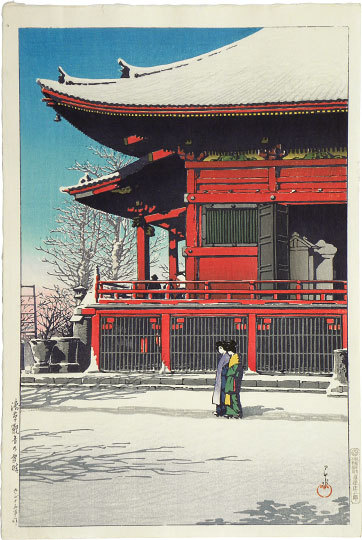
Twenty Views of Tokyo: Clearing After a Snowfall at the Asakusa Kannon Temple (Tokyo Nijukkei: Asakusa Kannon no yukibare)
by Kawase Hasui
- Series:
- Twenty Views of Tokyo
- Medium:
- Woodblock print
- Source:
- Scholten Japanese Art
- Image courtesy of
- Scholten Japanese Art
Description
From the 'Twenty Views of Tokyo' series. Sensoji temple in Asakusa is among the city's most significant Buddhist sites, and Hasui used its architectural grandeur as a vehicle for weather observation. 'Yukibare' refers to the moment of clearing skies following snowfall, a transitional atmospheric condition Hasui returned to repeatedly. The composition likely features the Nakamise approach or the Nitenmon blanketed in fresh snow, with the five-story pagoda rising into a brightening sky to one side. The red-lacquered gate pillars and temple woodwork contrast with white snow accumulations along rooflines and courtyard paving. Gradated bokashi in the sky, moving from deep blue-gray at the zenith to pale luminescence near the horizon, conveys winter light breaking through dispersing cloud. Figures in winter coats may appear small in the distance, anchoring the vast architectural space. The print belongs to a period when Hasui documented Tokyo's historically significant sites with the same atmospheric precision he applied to rural Japan.
More Prints by Kawase Hasui

More Edo & Tokyo Prints

Komagata Embankment
Early Summer 1919
Woodblock print, ink and color on paper

View of Tsukuda Island from Eitai Bridge (Eitaibashi Tsukudajima), from the series "One Hundred Famous Views of Edo (Meisho Edo hyakkei)"
Color woodblock print

Yanagishima, from the series "One Hundred Famous Views of Edo (Meisho Edo hyakkei)"
Color woodblock print

Kasumigaseki, from the series “One Hundred Famous Views of Edo (Meisho Edo hyakkei)”
Color woodblock print
Featured in Collections
Curated cross-cuts that include this print.
Frequently Asked Questions
Twenty Views of Tokyo: Clearing After a Snowfall at the Asakusa Kannon Temple (Tokyo Nijukkei: Asakusa Kannon no yukibare) was created by Kawase Hasui (川瀬巴水).
Yes — Twenty Views of Tokyo: Clearing After a Snowfall at the Asakusa Kannon Temple (Tokyo Nijukkei: Asakusa Kannon no yukibare) is part of the Twenty Views of Tokyo series by Kawase Hasui.
Twenty Views of Tokyo: Clearing After a Snowfall at the Asakusa Kannon Temple (Tokyo Nijukkei: Asakusa Kannon no yukibare) depicts edo & tokyo, snow scenes, and famous places (meisho-e).