
Winter at Lake Ashino (Ashinoko no fuyu)
by Kawase Hasui
- Date:
- 1949
- Medium:
- Color woodblock print
- Format:
- Oban
- Publisher:
- Watanabe Shozaburo
- Edition:
- Published by Watanabe Shozaburo
- Source:
- Art Institute of Chicago
Description
A snow-capped Mount Fuji rises beyond green hills, framed between the dark trunks of two large trees and overhanging branches in the foreground, with its reflection mirrored in the still blue-green waters of the lake below. A pale sky with faint clouds stretches above the mountain, and no human figures appear in the scene. *Winter at Lake Ashino (Ashinoko no fuyu)*, color woodblock print by Kawase Hasui, 1949.
More Prints by Kawase Hasui

More Landscapes Prints

Lake Kugushi in Wakasa Province (Wakasa Kugushiko), from the series Souvenirs of Travel I (Tabi miyage dai isshu)"
Wakasa Kugushiko
1920
Color woodblock print; oban
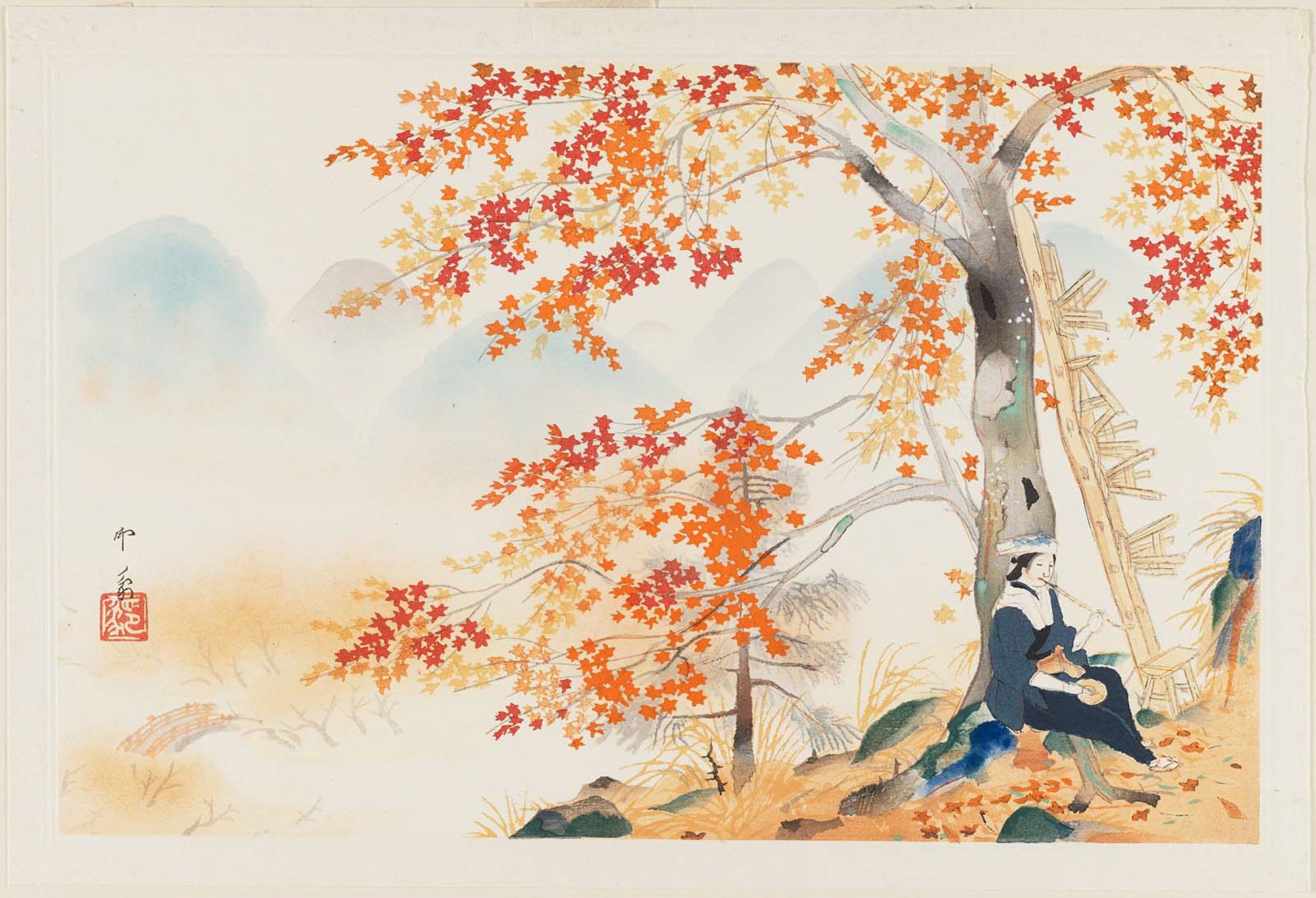
Autumn Maple Leaves at Takao, from the album Eight Views of Kyoto (Kyôto hakkei)
Woodblock print

The Beach at Kaiganji in Sanuki Province (Sanuki Kaiganji no hama), from the series "Collection of Views of Japan II, Kansai Edition (Nihon fukei shu II Kansai hen)"
1934
Color woodblock print; oban

Tea Kettle, section of a sheet from the series "Mirror of Stone Rubbings of Views of the Provinces" (Kohon meihitsu ishizuri kagami)
n.d.
Woodblock print; ishizuri-e, section of harimaze sheet
Featured in Collections
Curated cross-cuts that include this print.
Frequently Asked Questions
Winter at Lake Ashino (Ashinoko no fuyu) was created by Kawase Hasui (川瀬巴水) in 1949.
Winter at Lake Ashino (Ashinoko no fuyu) uses Bokashi, on color woodblock print.
Winter at Lake Ashino (Ashinoko no fuyu) was published by Watanabe Shozaburo (1949).
Winter at Lake Ashino (Ashinoko no fuyu) depicts landscapes, rivers & lakes, and winter.