
Noodle shop at Horyuji Temple village
by Oda Kazuma
- Medium:
- Mokuhanga (Japanese woodblock)
- Image courtesy of
- Saru Gallery
Description
A meisho-e (famous-place picture) of the village surrounding Hōryū-ji, the seventh-century temple complex in Nara prefecture. Rather than turning to the temple's well-known architecture, Kazuma directs attention to a humble noodle shop nearby — a characteristically sosaku hanga choice that prioritises lived everyday experience over monumental tradition. The image likely shows a low wooden eatery with shop curtains (noren) and signage, perhaps with figures seated or a vendor at work. The mokuhanga medium suits the rough textures of village architecture; the wood grain itself can contribute to the description of weathered timber and earth surfaces. This treatment aligns Kazuma with sosaku hanga peers such as Hiratsuka Un'ichi, who likewise documented temple-town atmosphere through quotidian detail rather than ceremonial grandeur, and reflects the movement's broader interest in regional Japan beyond its metropolitan centres.
More Prints by Oda Kazuma

More Temples & Shrines Prints
Fushimi Inari Temple
伏見稲荷
Woodblock print

The Compound of the Tenman Shrine at Kameido in the Snow (Kameido Tenmangu keidai no yuki), from the series "Famous Places in the Eastern Capital (Toto meisho)"
c. 1832/38
Color woodblock print; oban
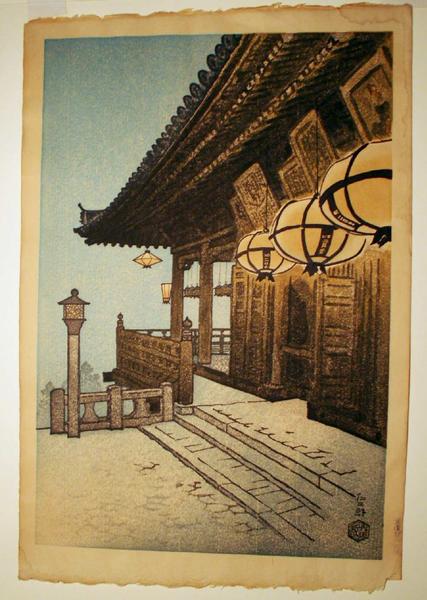
Temple with lanterns
Woodblock print

A Section of the Byodo Temple at Uji (Uji Byodoin no ichibu), from the series "Souvenirs of Travel, Second Series (Tabi miyage dai nishu)"
Uji Byodoin no ichibu
1921
Color woodblock print; oban
Featured in Collections
Curated cross-cuts that include this print.
Frequently Asked Questions
Noodle shop at Horyuji Temple village was created by Oda Kazuma (織田一磨).
Noodle shop at Horyuji Temple village depicts temples & shrines, food & drink, and village scenes.