
Aoki harbour in winter
by Maeda Masao
- Medium:
- Mokuhanga (Japanese woodblock)
- Image courtesy of
- Saru Gallery
Description
A winter harbor scene speaks directly to Maeda's Hokkaido origins, where ports along the northern coast spent months locked in ice and pale grey light. Aoki Harbor offers the standard ingredients of the northern marine subject: moored fishing vessels, snow-laden quays, and the muted tonal range that distinguishes Hokkaido landscape printing from the warmer palettes of Honshu shin-hanga. Compositionally such a print would typically set vertical masts against the horizontal banding of water and shoreline, with extensive bokashi gradations rendering overcast sky and slate-colored sea. Areas left as bare washi carry the weight of accumulated snow on rigging, hulls, and piers without the addition of pigment, an effect that depends on careful registration of the surrounding blocks. For Maeda, whose career demonstrated how permeable the boundary between shin-hanga and sosaku-hanga could be, a winter port draws on the topographical sensibility of his northern upbringing alongside the lyrical landscape tradition that Hasui and others extended through publisher-driven series during the same decades.
More Prints by Maeda Masao
More Seascapes Prints
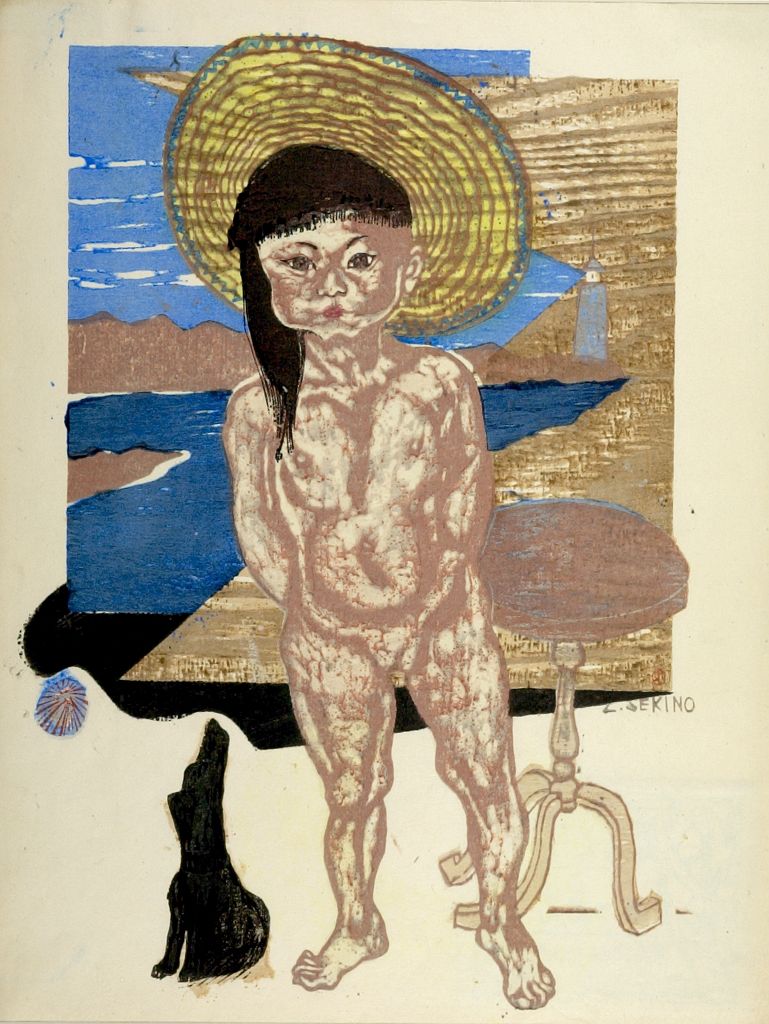
Child of the Sea
1940
Woodblock print

The Beach at Kaiganji in Sanuki Province (Sanuki Kaiganji no hama), from the series "Collection of Views of Japan II, Kansai Edition (Nihon fukei shu II Kansai hen)"
1934
Color woodblock print; oban

Pacific Ocean, Awa Province (Boshu Taikai), from the series "Souvenirs of Travel, Third Series (Tabi miyage dai sanshu)"
Boshu Taikai
1925
Color woodblock print; oban

Pine Beach at Miho (Miho no Matsubara), from the series "Selection of Views of the Tokaido (Tokaido fukei senshu)"
September 1931
Color woodblock print; oban
Featured in Collections
Curated cross-cuts that include this print.
Frequently Asked Questions
Aoki harbour in winter was created by Maeda Masao (前田政雄).
Aoki harbour in winter depicts seascapes and winter.