
Nakajima-kōen is the central public park of Sapporo, laid out around a curving pond on land reclaimed from a riverbank in the late nineteenth century. Its grounds hold the Hassō-an tea house and the Hōheikan, a Meiji-era Western-style guesthouse painted pale blue. As a Hokkaido subject, the park sat close to Maeda's lifelong terrain. A print bearing this title and tagged as a garden subject likely depicts the willows along the pond, the arched bridge, or the reflective water itself rather than the buildings — the kind of quietly composed landscape that lends itself to broad areas of color and selective keyblock detail. Maeda's prints from this orbit tend to feature flatter, more graphic groupings of trees, with woodgrain texture visible in passages of sky or water to register the wood's own contribution to the image. The park subject places him in dialogue with the [meisho-e](/glossary/meisho-e) tradition reframed for modern public spaces, where the city park rather than the shrine grove becomes the contemplative setting.
![[Garden of] Taj Mahal, No. 1 (Taji Maharu no niwa, dai ichi) by Hiroshi Yoshida](https://www.artic.edu/iiif/2/230993a7-d4f0-c979-c267-127d48e1ef1c/full/843,/0/default.jpg)
Taji Maharu no niwa, dai ichi
1931
Color woodblock print; oban

January 1938
Woodblock print, ink and color on paper

1938
Color woodblock print; oban
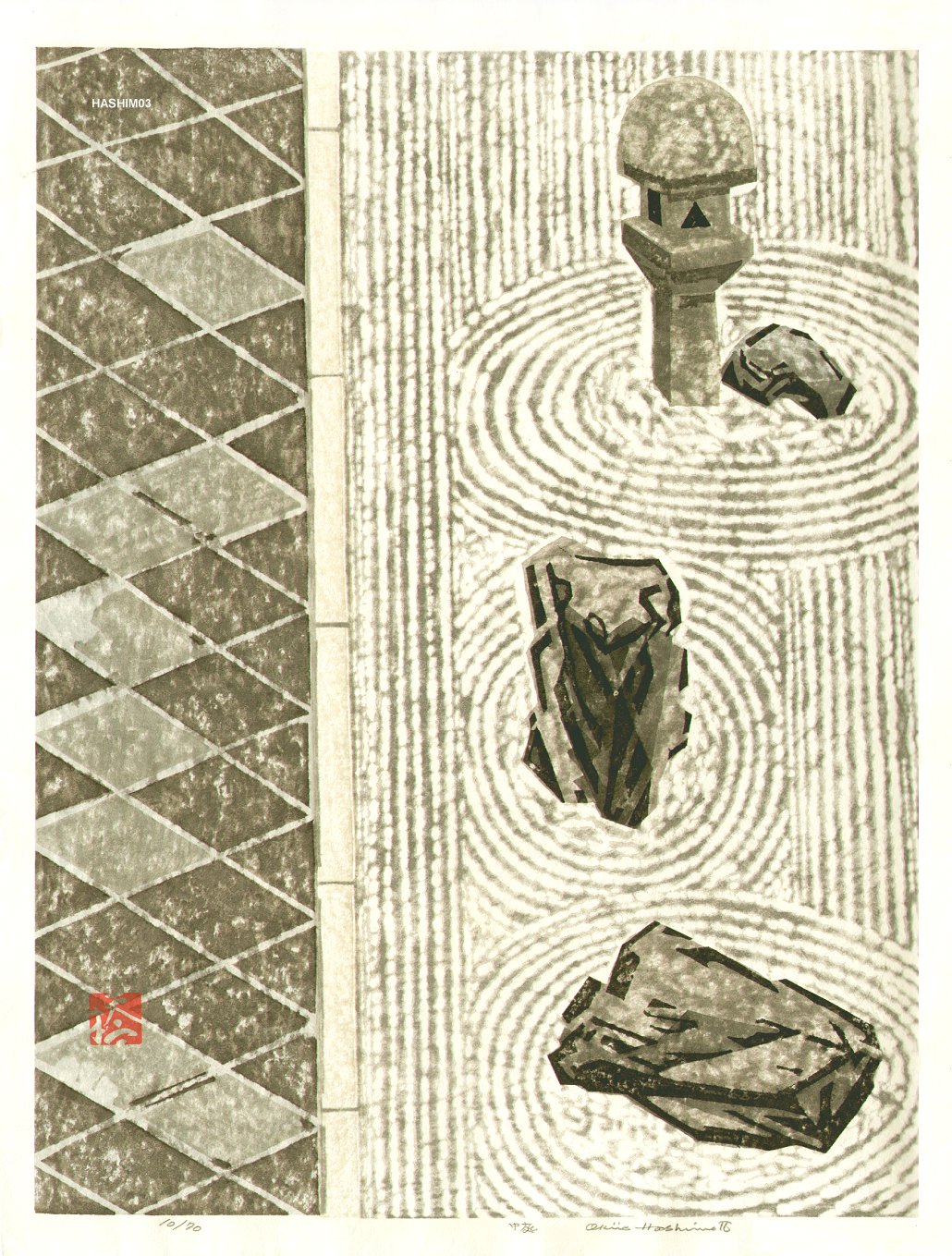
10/70, 1966
Woodblock print
Curated cross-cuts that include this print.
Nakajima Park was created by Maeda Masao (前田政雄).
Nakajima Park depicts gardens.


