
Rock Garden
by Maeda Masao
- Medium:
- Mokuhanga (Japanese woodblock)
- Image courtesy of
- Saru Gallery
Description
A karesansui (dry landscape garden) of raked gravel and arranged stones, the Zen temple garden tradition associated with Kyoto sites such as Ryoan-ji, Daisen-in, and Tofuku-ji. The compositional challenge for a printmaker is the garden's near-emptiness: large fields of negative space punctuated by rocks, with the raked gravel patterns providing the only sustained linear incident. Maeda would likely have used the woodgrain of the block to suggest the parallel rake lines across the gravel — a sosaku-hanga technique that lets the material of the medium do the descriptive work. The walled enclosure typical of these gardens provides a strong rectangular frame within the print, and the rocks read as silhouettes or simplified mass. The subject aligns Maeda with mid-century printmakers who turned to Zen aesthetics as a register of Japanese pictorial restraint, an answer to Western abstraction that drew on indigenous tradition rather than imported it.
More Prints by Maeda Masao
More Gardens Prints
![[Garden of] Taj Mahal, No. 1 (Taji Maharu no niwa, dai ichi) by Hiroshi Yoshida](https://www.artic.edu/iiif/2/230993a7-d4f0-c979-c267-127d48e1ef1c/full/843,/0/default.jpg)
[Garden of] Taj Mahal, No. 1 (Taji Maharu no niwa, dai ichi)
Taji Maharu no niwa, dai ichi
1931
Color woodblock print; oban

Kiyozumi Garden in Moonlight
January 1938
Woodblock print, ink and color on paper

Moon over Kiyosumi Garden (Tsuki no Kiyosumien)
1938
Color woodblock print; oban
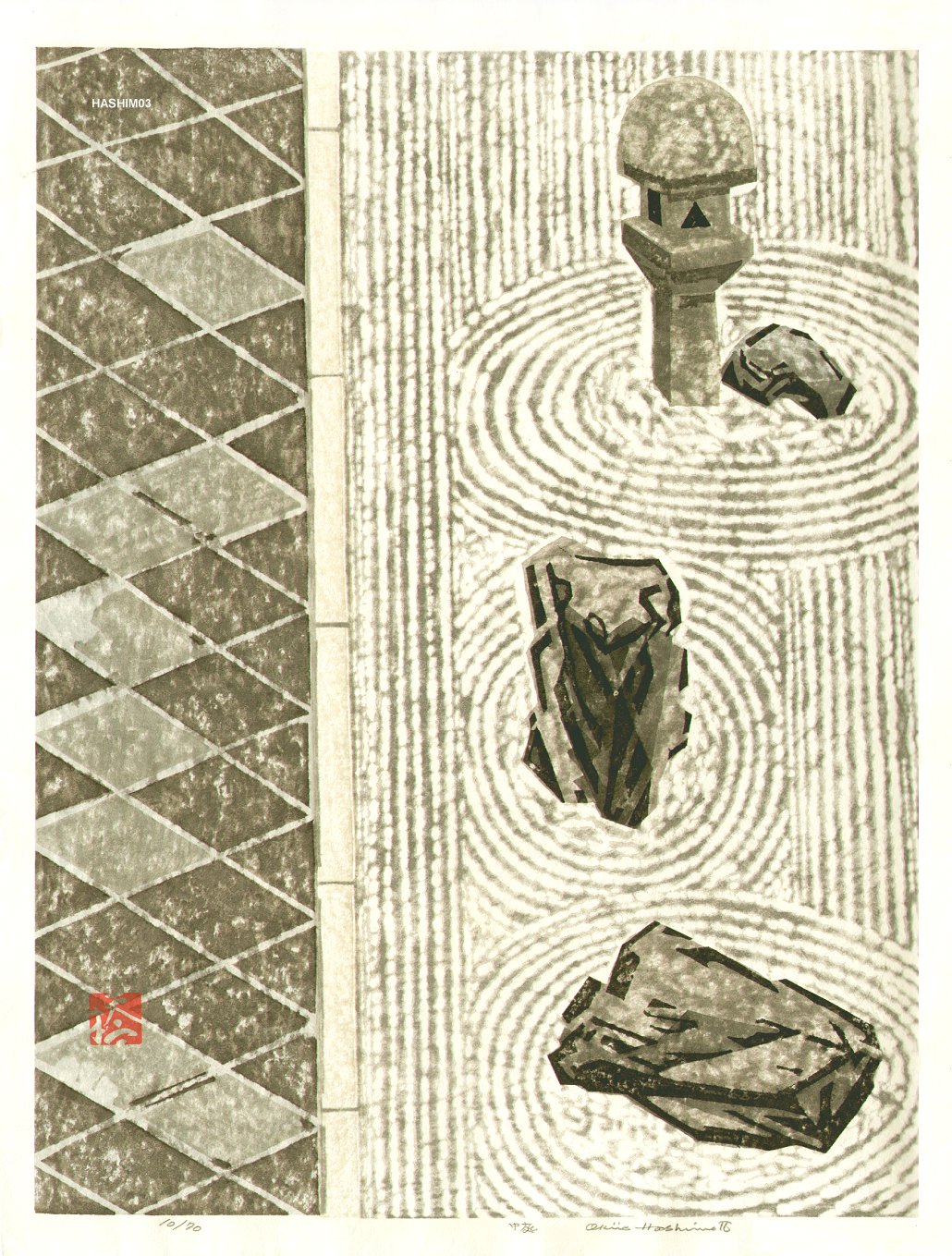
Rock garden
10/70, 1966
Woodblock print
Featured in Collections
Curated cross-cuts that include this print.
Frequently Asked Questions
Rock Garden was created by Maeda Masao (前田政雄).
Rock Garden depicts gardens.