
Ryoan-ji rock garden B
by Maeda Masao
- Medium:
- Mokuhanga (Japanese woodblock)
- Image courtesy of
- Saru Gallery
Description
Ryōan-ji's karesansui garden in Kyoto—fifteen rocks arranged in raked white gravel within a walled rectangle—is one of the most-depicted subjects in twentieth-century Japanese printmaking, and Maeda's treatment, marked B to distinguish it from a companion design, joins versions by Asano Takeji, Tokuriki Tomikichirō, and others. The composition almost requires a high or oblique viewpoint to read the rock placements, and the print likely reduces the scene to a few essential planes: the pale field of gravel, the dark earth-tone tile-capped wall, the shadowed verandah of the abbot's quarters, and the rocks themselves printed with grain and bokashi to suggest weathered stone. Maeda's sosaku-hanga practice would have used hand-carving to give the rocks individual character rather than the smoothed contours a publisher's carver might have produced. The garden subject sits within his wider interest in compositions where negative space and texture do most of the expressive work.
More Prints by Maeda Masao
More Gardens Prints
![[Garden of] Taj Mahal, No. 1 (Taji Maharu no niwa, dai ichi) by Hiroshi Yoshida](https://www.artic.edu/iiif/2/230993a7-d4f0-c979-c267-127d48e1ef1c/full/843,/0/default.jpg)
[Garden of] Taj Mahal, No. 1 (Taji Maharu no niwa, dai ichi)
Taji Maharu no niwa, dai ichi
1931
Color woodblock print; oban

Kiyozumi Garden in Moonlight
January 1938
Woodblock print, ink and color on paper

Moon over Kiyosumi Garden (Tsuki no Kiyosumien)
1938
Color woodblock print; oban
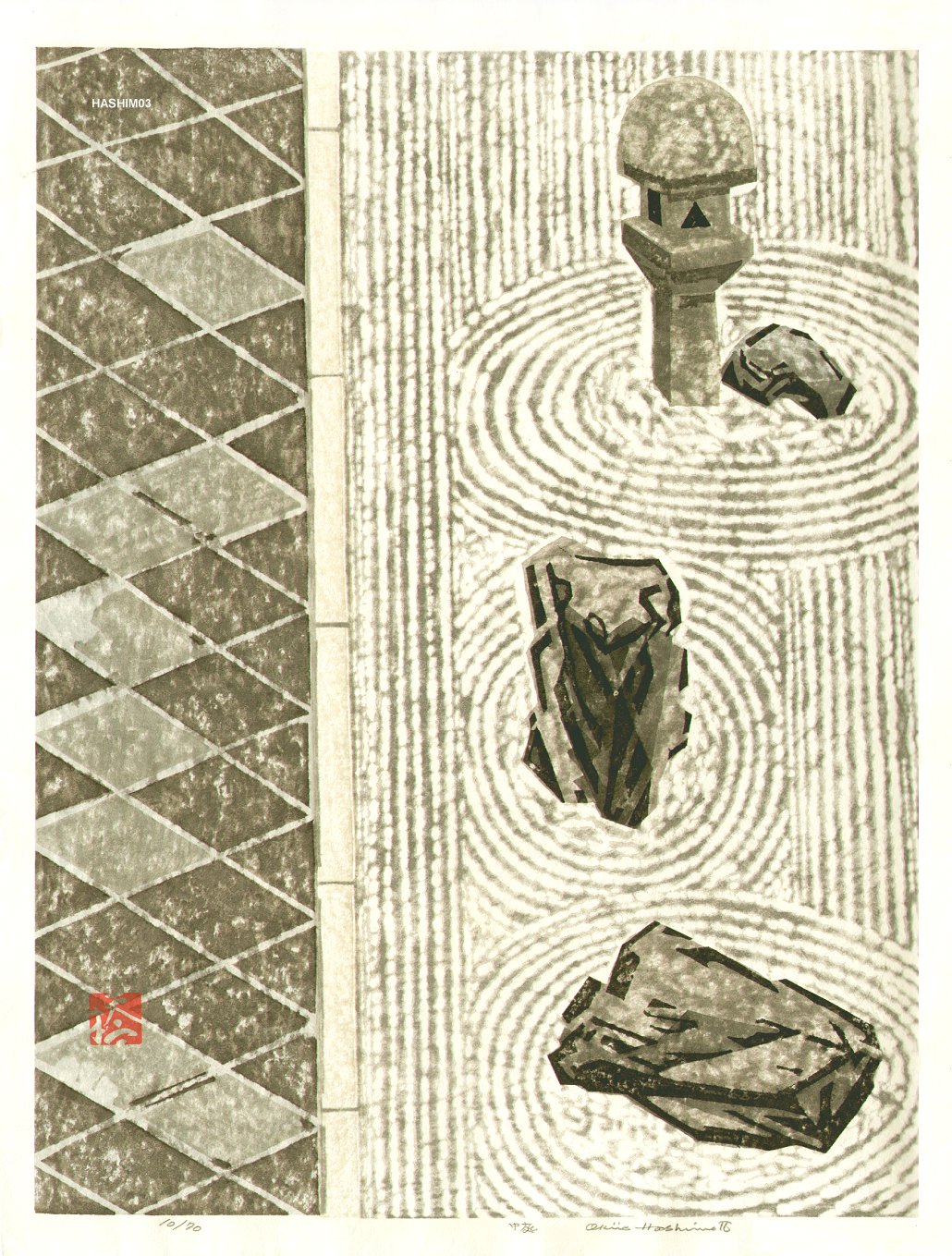
Rock garden
10/70, 1966
Woodblock print
Featured in Collections
Curated cross-cuts that include this print.
Frequently Asked Questions
Ryoan-ji rock garden B was created by Maeda Masao (前田政雄).
Ryoan-ji rock garden B depicts gardens.