
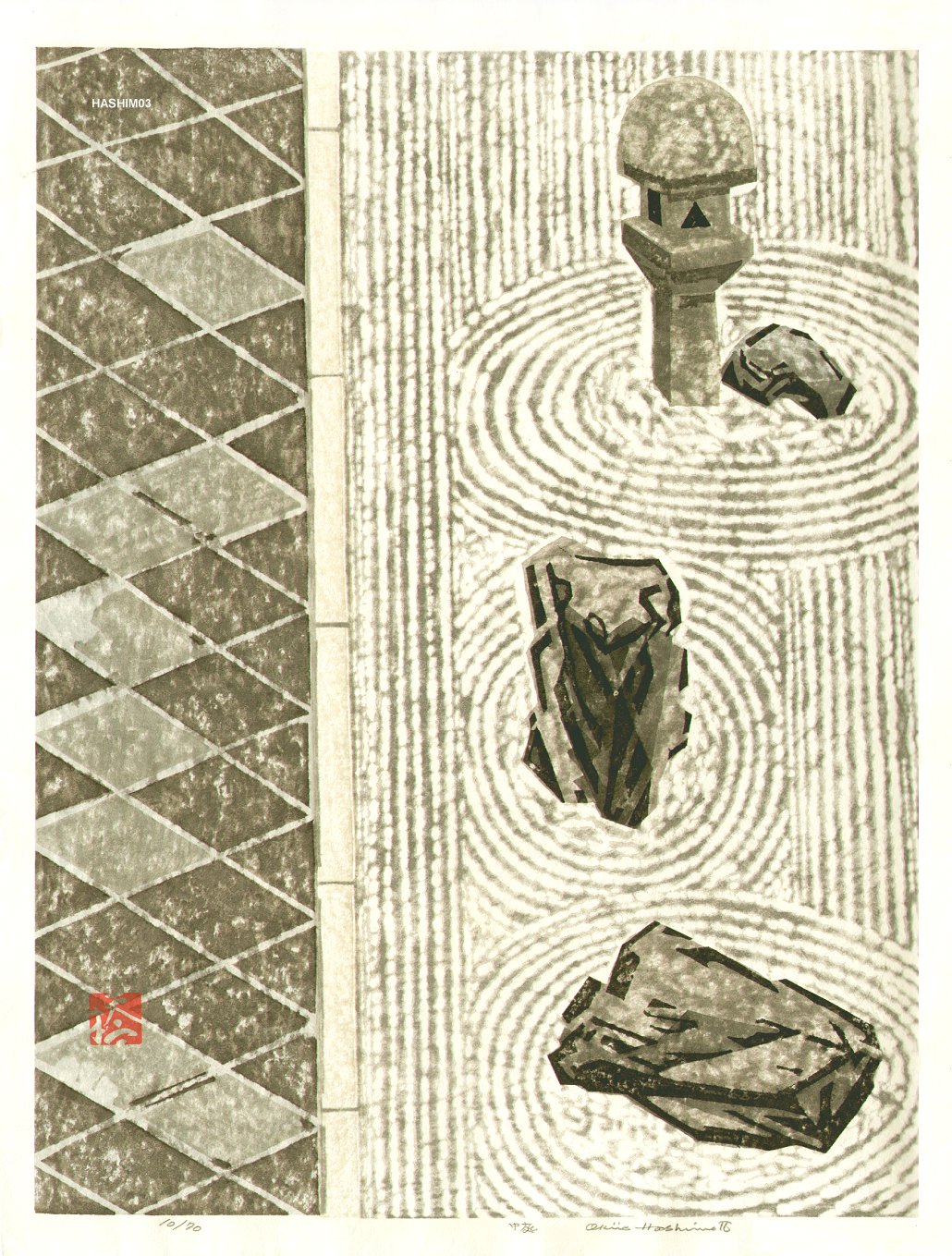
Stone Garden, a second variant in Maeda's treatment of karesansui subjects, points to a Zen temple dry garden of the type found at Ryōan-ji, Daitoku-ji, or Tōfuku-ji—gravel raked into linear or concentric patterns around a small group of standing rocks. The print likely isolates a corner of such a garden, framed perhaps by a cropped section of viewing verandah or the base of a tile-capped earthen wall. Karesansui subjects suit hand-carved blocks because the raked gravel can be incised directly into the wood as parallel grooves, and the printed lines retain the slight irregularity of the carving tool. [Bokashi](/glossary/bokashi) in the gravel field can suggest the long shadow cast across it by the temple buildings. Garden subjects formed a substantial portion of Maeda's output, particularly in the postwar decades when temple gardens became a recurrent subject for [sosaku-hanga](/glossary/sosaku-hanga) artists addressing both Japanese audiences and the foreign collectors then taking interest in the movement.
![[Garden of] Taj Mahal, No. 1 (Taji Maharu no niwa, dai ichi) by Hiroshi Yoshida](https://www.artic.edu/iiif/2/230993a7-d4f0-c979-c267-127d48e1ef1c/full/843,/0/default.jpg)
Taji Maharu no niwa, dai ichi
1931
Color woodblock print; oban

January 1938
Woodblock print, ink and color on paper

1938
Color woodblock print; oban
10/70, 1966
Woodblock print
Curated cross-cuts that include this print.
Stone Garden was created by Maeda Masao (前田政雄).
Stone Garden depicts gardens.


