
Asakusa Kwannon temple
- Medium:
- Mokuhanga (Japanese woodblock)
- Image courtesy of
- Saru Gallery
Description
A large temple hall with a steeply raked, dark tiled roof and vermillion pillars dominates the composition, its wide eaves sheltering a row of small distant figures on the veranda. Below, a dense crowd of silhouetted worshippers and visitors in dark coats and hats — with a few figures in patterned kimono in red, teal, and purple — fills the courtyard among awnings, a stone lantern, and bare, mineral-orange winter trees, under a mottled blue sky. The palette is limited to black, burnt orange/gold, teal, dusky red, and pale blue, printed with visible wood grain texture; the scene reads as a crowded temple approach in cold-weather dress.
Title: Asakusa Kwannon Temple. Artist: Saito Kiyoshi. Medium: Mokuhanga (Japanese woodblock).
More Prints by Saito Kiyoshi
More Temples & Shrines Prints
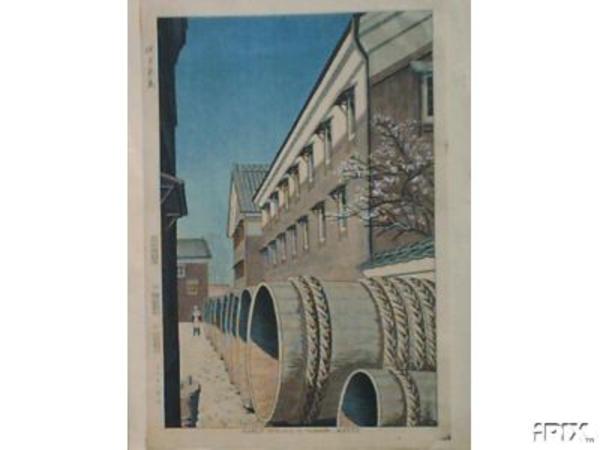
Fushimi Inari Temple
伏見稲荷
Woodblock print

The Compound of the Tenman Shrine at Kameido in the Snow (Kameido Tenmangu keidai no yuki), from the series "Famous Places in the Eastern Capital (Toto meisho)"
c. 1832/38
Color woodblock print; oban
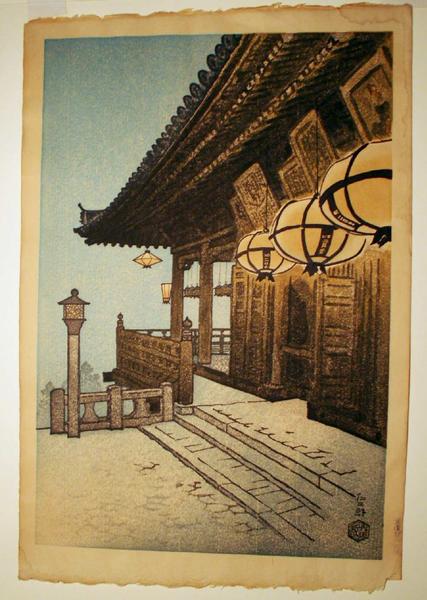
Temple with lanterns
Woodblock print

A Section of the Byodo Temple at Uji (Uji Byodoin no ichibu), from the series "Souvenirs of Travel, Second Series (Tabi miyage dai nishu)"
Uji Byodoin no ichibu
1921
Color woodblock print; oban
Featured in Collections
Curated cross-cuts that include this print.
Frequently Asked Questions
Asakusa Kwannon temple was created by Saito Kiyoshi (斎藤清).
Asakusa Kwannon temple depicts temples & shrines.