
Asakusa Kwannon temple
- Medium:
- Mokuhanga (Japanese woodblock)
- Image courtesy of
- Saru Gallery
Description
A second composition addressing the Asakusa Kannon temple complex, likely showing a different vantage, structure, or compositional emphasis within Saito's broader treatment of the site. Saito habitually produced multiple variants of important subjects, refining cropping, palette, and compositional weighting across successive impressions. This variant may concentrate on a single architectural element — the five-story pagoda, the great paper lantern of the kaminarimon, the eaves of the hondo — isolated against an abstracted ground. His temple prints typically employ a limited palette anchored by black, vermilion (the traditional cinnabar of shrine architecture), and the natural off-white of washi, with selective bokashi gradations softening transitions where used. The wood grain of the cherry block is preserved as part of the image rather than suppressed, a signature of Saito's mature style that visibly distinguishes his prints from both the polished surfaces of Edo-period nishiki-e and the tonal smoothness of his shin-hanga contemporaries such as Hasui and Yoshida Hiroshi.
More Prints by Saito Kiyoshi


More Temples & Shrines Prints
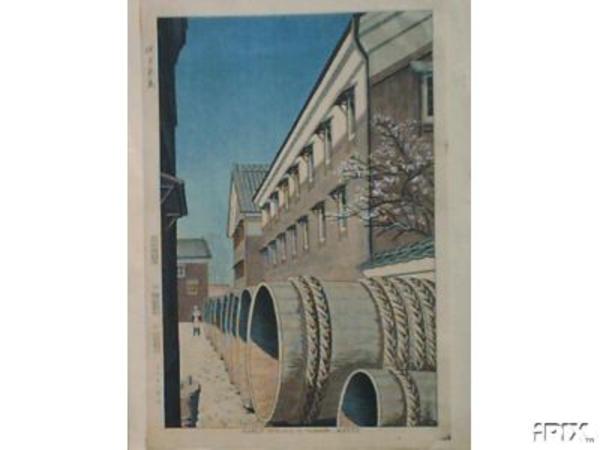
Fushimi Inari Temple
伏見稲荷
Woodblock print

The Compound of the Tenman Shrine at Kameido in the Snow (Kameido Tenmangu keidai no yuki), from the series "Famous Places in the Eastern Capital (Toto meisho)"
c. 1832/38
Color woodblock print; oban
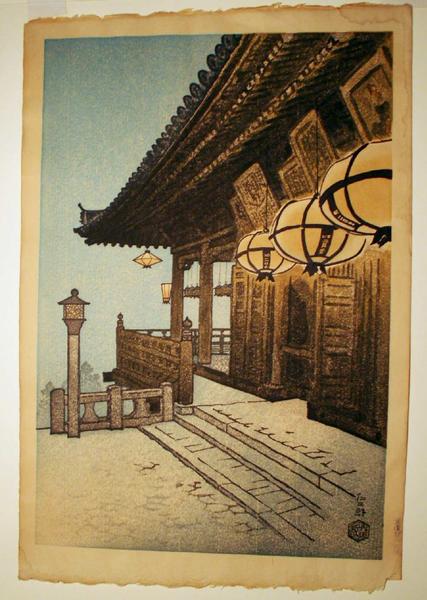
Temple with lanterns
Woodblock print

A Section of the Byodo Temple at Uji (Uji Byodoin no ichibu), from the series "Souvenirs of Travel, Second Series (Tabi miyage dai nishu)"
Uji Byodoin no ichibu
1921
Color woodblock print; oban
Featured in Collections
Curated cross-cuts that include this print.
Frequently Asked Questions
Asakusa Kwannon temple was created by Saito Kiyoshi (斎藤清).
Asakusa Kwannon temple depicts temples & shrines.