
Temple
- Medium:
- Mokuhanga (Japanese woodblock)
- Image courtesy of
- Saru Gallery
Description
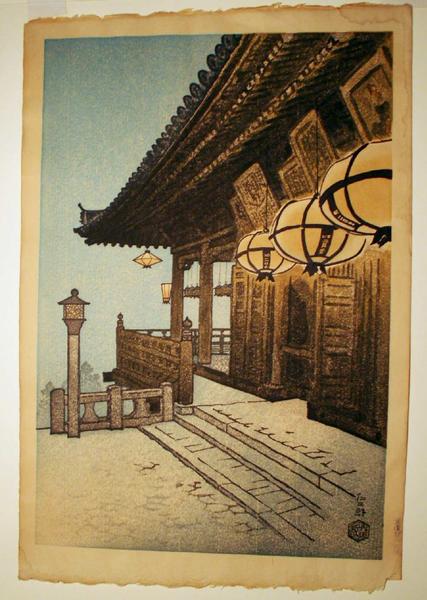
A characteristic example of Saito's temple subjects, in which he reduced Buddhist architecture to its strongest graphic elements: the sweeping curve of a tiled roof, the dark recess beneath the eaves, the rhythm of bracketing or vertical pillars, and an occasional vermillion accent. Saito traveled extensively among the temples of Kyoto, Nara, and the eastern provinces, and his architectural prints isolate one telling fragment rather than offering the panoramic prospect of an Edo-period meisho-e. The grain of the woodblock is frequently allowed to read through wall and pavement, lending the surface a sense of weathered age. Color is restrained — sumi-like blacks, earth tones, and a single saturated accent — and the carving favors broad, decisive shapes over fine line. Such works exemplify the sosaku-hanga emphasis on personal vision over reproductive technique, and they helped define a postwar visual vocabulary for Japanese architectural heritage seen through a modernist lens.
More Prints by Saito Kiyoshi


More Temples & Shrines Prints
Fushimi Inari Temple
伏見稲荷
Woodblock print

The Compound of the Tenman Shrine at Kameido in the Snow (Kameido Tenmangu keidai no yuki), from the series "Famous Places in the Eastern Capital (Toto meisho)"
c. 1832/38
Color woodblock print; oban
Temple with lanterns
Woodblock print

A Section of the Byodo Temple at Uji (Uji Byodoin no ichibu), from the series "Souvenirs of Travel, Second Series (Tabi miyage dai nishu)"
Uji Byodoin no ichibu
1921
Color woodblock print; oban
Featured in Collections
Curated cross-cuts that include this print.
Frequently Asked Questions
Temple was created by Saito Kiyoshi (斎藤清).
Temple depicts temples & shrines.