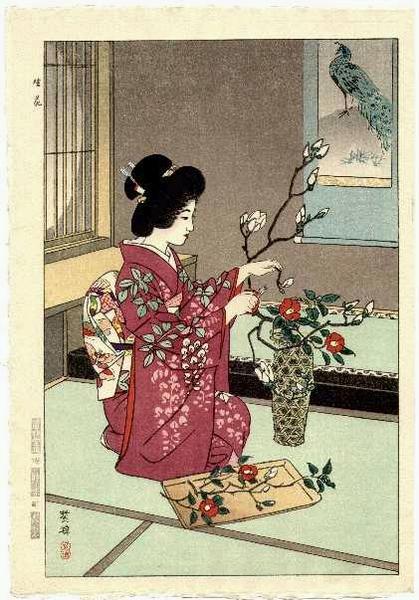
Ikebana
- Medium:
- Woodblock print
- Format:
- Oban
- Publisher:
- Watanabe Shozaburo
- Edition:
- Published by Watanabe Shozaburo
- Source:
- ukiyo-e.org
Description
A ikebana arrangement — the Japanese art of flower arranging that transforms cut materials into compositional statements about season, space, and form — appears as a still-life subject in Kasamatsu's printmaking. Ikebana's principles of asymmetry, negative space, and the relationship between the arrangement and its vessel gave Kasamatsu formal problems analogous to those he faced in landscape composition: how to organize natural materials within a defined space in a way that feels necessary rather than arbitrary.
More Prints by Shiro Kasamatsu
More Still Life Prints


Featured in Collections
Curated cross-cuts that include this print.
Frequently Asked Questions
Ikebana was created by Shiro Kasamatsu (笠松紫浪).
Ikebana uses Bokashi, Nishiki-e, and Moku-hanga, on woodblock print.
Ikebana was published by Watanabe Shozaburo.
Ikebana depicts still life.