
Five-storied Pagoda (Goju no to)
- Date:
- c. 1936
- Medium:
- Color woodblock print
- Format:
- Oban
- Publisher:
- Watanabe Shozaburo
- Edition:
- Published by Watanabe Shozaburo
- Source:
- Art Institute of Chicago
Description
The five-storied pagoda — Goju no to — is the quintessential form of Japanese Buddhist architecture, its stacked tiers and tapering finial creating a vertical axis that oriented worshippers toward the sky. Shotei's circa 1936 treatment renders the pagoda emerging from surrounding trees, its architectural form both precisely observed and atmospherically softened by the bokashi sky above. The subject was canonical in Japanese landscape art, but Shotei brought to it the intimate, quietly absorbed quality that distinguished his work from more monumental treatments.
More Prints by Takahashi Shotei


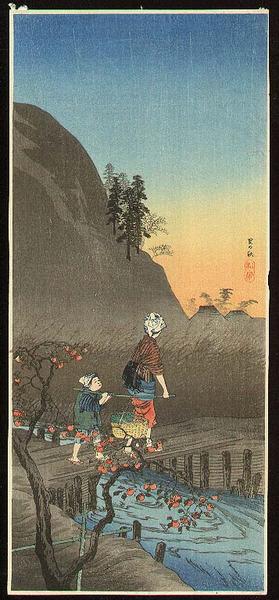

More Temples & Shrines Prints
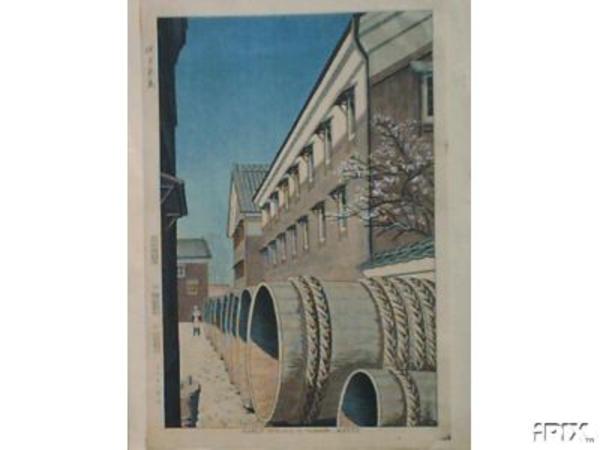
Fushimi Inari Temple
伏見稲荷
Woodblock print

The Compound of the Tenman Shrine at Kameido in the Snow (Kameido Tenmangu keidai no yuki), from the series "Famous Places in the Eastern Capital (Toto meisho)"
c. 1832/38
Color woodblock print; oban
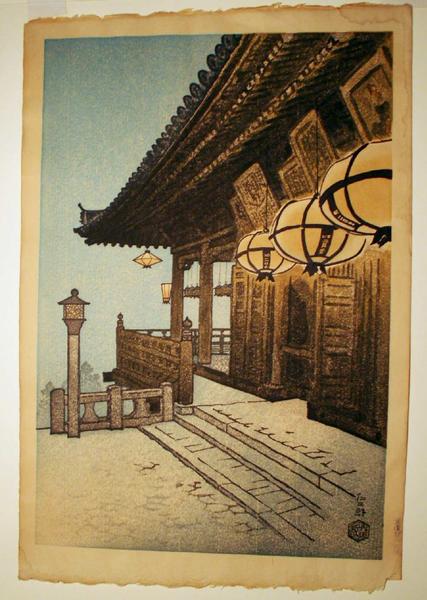
Temple with lanterns
Woodblock print

A Section of the Byodo Temple at Uji (Uji Byodoin no ichibu), from the series "Souvenirs of Travel, Second Series (Tabi miyage dai nishu)"
Uji Byodoin no ichibu
1921
Color woodblock print; oban
Featured in Collections
Curated cross-cuts that include this print.
Frequently Asked Questions
Five-storied Pagoda (Goju no to) was created by Takahashi Shotei (高橋松亭) in c. 1936.
Five-storied Pagoda (Goju no to) was published by Watanabe Shozaburo (c. 1936).
Five-storied Pagoda (Goju no to) depicts temples & shrines and pagodas.