
Fireworks At Ryogoku-bashi bridge
- Medium:
- Mokuhanga (Japanese woodblock)
- Image courtesy of
- Saru Gallery
Description
Fireworks at Ryogoku Bridge revisits one of the most enduring meisho-e subjects in Japanese printmaking, treated memorably by Hiroshige in his Hundred Famous Views of Edo. The annual summer fireworks over the Sumida River, launched from the Ryogoku district, drew crowds of spectators in pleasure boats and along the embankments. Shotei's composition likely silhouettes the arc of the bridge against a dark sky punctuated by exploding fireworks, with reflections scattering across the water below and small figures populating the scene. Achieving the brightness of fireworks against deep night demands precise registration of small color blocks against expansive dark fields, with the printer building the night sky through repeated impressions of indigo or sumi. The subject ties Shotei explicitly to the Edo pictorial tradition while allowing the softer atmospheric approach of shin-hanga to inflect the treatment. Festival and night-scene combinations like this one were popular with both domestic and Western collectors during the Taisho and early Showa periods, and Shotei produced many variant compositions on related themes.
More Prints by Takahashi Shotei


More Bridges Prints
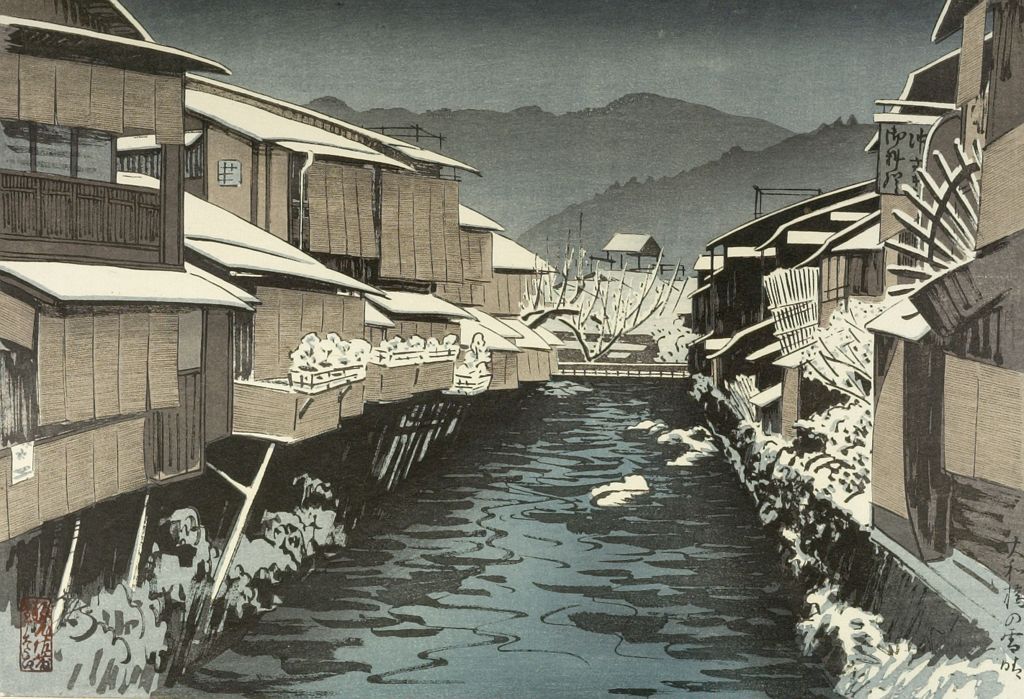
Fair Weather After Snow at Yamato Bridge, Kyoto (Yamato bashi no yukibare), Taishô period, dated 1924
Woodblock print
![Mount Fuji on a Moonlit Night, Kawai Bridge (Tsukiyo no Fuji [Kawaibashi]), from the series "Selection of Views of the Tokaido (Tokaido fukei senshu)" by Kawase Hasui](https://www.artic.edu/iiif/2/d0960668-1e73-339a-b182-fb995a54bff0/full/843,/0/default.jpg)
Mount Fuji on a Moonlit Night, Kawai Bridge (Tsukiyo no Fuji [Kawaibashi]), from the series "Selection of Views of the Tokaido (Tokaido fukei senshu)"
1947
Color woodblock print; oban

Shin Ohashi Bridge (Shin Ohashi), from the series "Twenty View of Tokyo (Tokyu nijukkei)"
1926
Color woodblock print; oban

Sacred Bridge in Nikko (Nikko Shinkyo)
1930
Color woodblock print; oban
Featured in Collections
Curated cross-cuts that include this print.
Frequently Asked Questions
Fireworks At Ryogoku-bashi bridge was created by Takahashi Shotei (高橋松亭).
Fireworks At Ryogoku-bashi bridge depicts bridges and festivals.