
Mannen Bridge
- Medium:
- Mokuhanga (Japanese woodblock)
- Image courtesy of
- Saru Gallery
Description
Mannen-bashi, the Eternal Bridge spanning the Onagi River in Tokyo's Fukagawa district, was a meisho-e subject treated by Hokusai and Hiroshige before Shotei addressed it. Shotei's version belongs to his extensive series of Tokyo and Edo views produced for the publisher Watanabe Shozaburo and other publishers from the late Meiji period onward. The composition likely emphasizes the arc of the bridge against water and sky, employing the atmospheric perspective that distinguishes Shotei's landscape work from earlier ukiyo-e treatments of the same locations. Careful bokashi in the sky and water, applied by the printer with a damp brush across the woodblock, would establish the time of day and weather. Shotei's Tokyo views document a city undergoing rapid modernization, often choosing to depict bridges, temples, and waterways in a state suggesting the older Edo rather than the trams and Western buildings of the contemporary metropolis. This nostalgic vision of place became a defining characteristic of his contribution to shin-hanga's broader project.
More Prints by Takahashi Shotei

More Bridges Prints
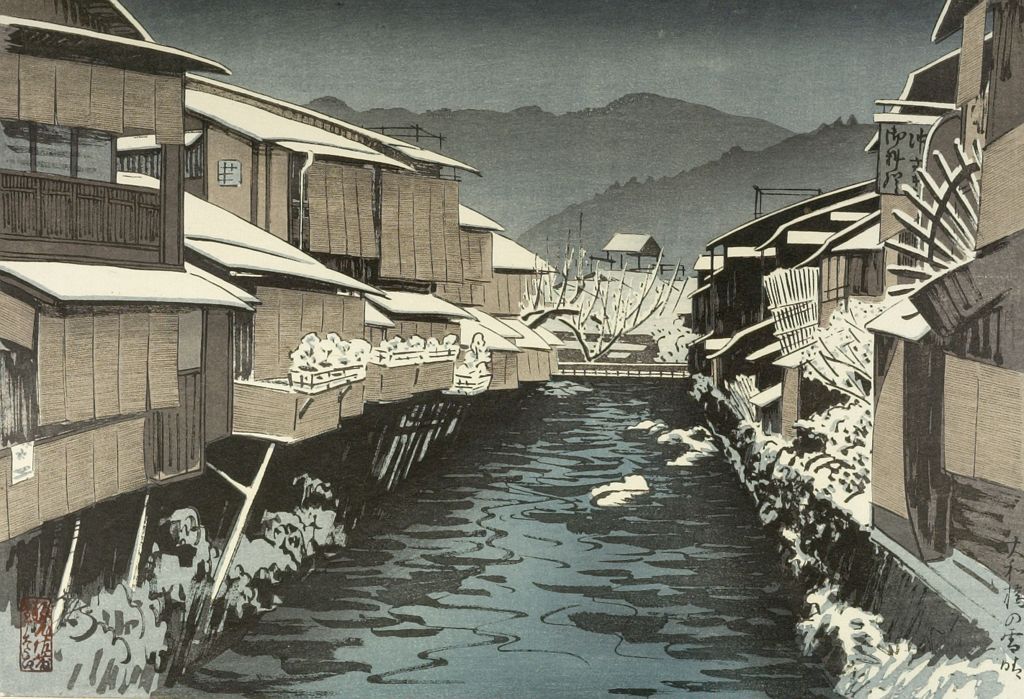
Fair Weather After Snow at Yamato Bridge, Kyoto (Yamato bashi no yukibare), Taishô period, dated 1924
Woodblock print
![Mount Fuji on a Moonlit Night, Kawai Bridge (Tsukiyo no Fuji [Kawaibashi]), from the series "Selection of Views of the Tokaido (Tokaido fukei senshu)" by Kawase Hasui](https://www.artic.edu/iiif/2/d0960668-1e73-339a-b182-fb995a54bff0/full/843,/0/default.jpg)
Mount Fuji on a Moonlit Night, Kawai Bridge (Tsukiyo no Fuji [Kawaibashi]), from the series "Selection of Views of the Tokaido (Tokaido fukei senshu)"
1947
Color woodblock print; oban

Shin Ohashi Bridge (Shin Ohashi), from the series "Twenty View of Tokyo (Tokyu nijukkei)"
1926
Color woodblock print; oban

Sacred Bridge in Nikko (Nikko Shinkyo)
1930
Color woodblock print; oban
Featured in Collections
Curated cross-cuts that include this print.
Frequently Asked Questions
Mannen Bridge was created by Takahashi Shotei (高橋松亭).
Mannen Bridge depicts bridges.