
The Great Bridge at Senju
- Source:
- ukiyo-e.org
Description
The Great Bridge at Senju, recorded through the Japanese Art Open Database under a Hokuju Shotei attribution that traces back to Takahashi Shotei, depicts the long wooden bridge that crossed the Sumida at Senju on the northern edge of Edo. Senju was the first post-station on the Nikko Kaido and the bridge there was a major artery for both travelers and commercial traffic, a subject already explored in Edo-period ukiyo-e by Hiroshige and others. Shotei, signing in the shin-hanga era as Hiroaki, returns to the bridge and frames it through the soft tonal register cultivated by his publisher Watanabe Shozaburo, with bokashi-graded skies, careful registration of the bridge's wooden structure and subtle water gradients. The chuban landscape format helps compress the bridge's long span into an intimate sheet without sacrificing the diagonal sweep that makes the subject so visually inviting. The Hokuju Shotei attribution in the database record likely reflects an older or alternate art-name reading and underscores how the dispersed survival of Shotei's pre-1923 catalogue, much of it destroyed in the Great Kanto earthquake, has left cataloguers piecing together identities from signatures, seals and dealer histories. Senju was one of the points where old Edo met the wider road system to the north, and Shotei's treatment in the shin-hanga idiom continued the long tradition of imagining that edge of the city. The print is a useful entry in the broader Tokyo cycle through which the artist and Watanabe Shozaburo memorialized the capital's bridges.
More Prints by Takahashi Shotei

More Bridges Prints
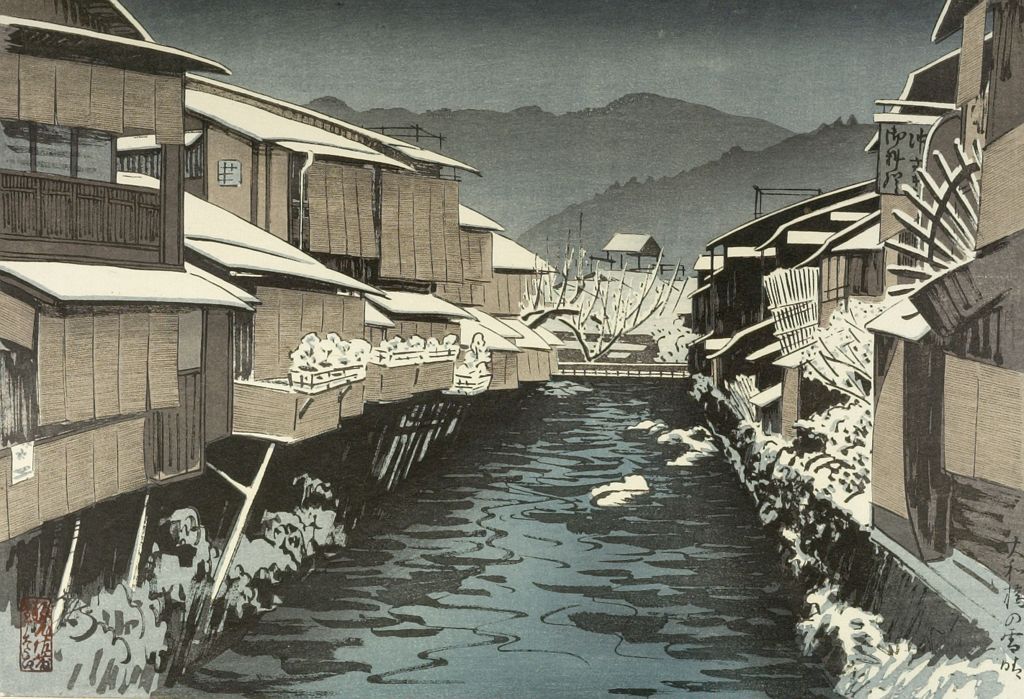
Fair Weather After Snow at Yamato Bridge, Kyoto (Yamato bashi no yukibare), Taishô period, dated 1924
Woodblock print
![Mount Fuji on a Moonlit Night, Kawai Bridge (Tsukiyo no Fuji [Kawaibashi]), from the series "Selection of Views of the Tokaido (Tokaido fukei senshu)" by Kawase Hasui](https://www.artic.edu/iiif/2/d0960668-1e73-339a-b182-fb995a54bff0/full/843,/0/default.jpg)
Mount Fuji on a Moonlit Night, Kawai Bridge (Tsukiyo no Fuji [Kawaibashi]), from the series "Selection of Views of the Tokaido (Tokaido fukei senshu)"
1947
Color woodblock print; oban

Shin Ohashi Bridge (Shin Ohashi), from the series "Twenty View of Tokyo (Tokyu nijukkei)"
1926
Color woodblock print; oban

Sacred Bridge in Nikko (Nikko Shinkyo)
1930
Color woodblock print; oban
Featured in Collections
Curated cross-cuts that include this print.
Frequently Asked Questions
The Great Bridge at Senju was created by Takahashi Shotei (高橋松亭).
The Great Bridge at Senju depicts bridges.