
Mt Fuji
- Medium:
- Mokuhanga (Japanese woodblock)
- Image courtesy of
- Saru Gallery
Description
Without a specified viewpoint, this print likely belongs to one of Tokuriki's Fuji series — he produced more than one set explicitly modelled on Hokusai's Thirty-Six Views — in which the mountain is treated from a range of locations, seasons, and times of day. A close-in view of the mountain itself would emphasise the cone's distinctive profile, with snow rendered as the unprinted white of the washi paper and the volcanic body built up through layered indigo and grey blocks. Bokashi shading on the slopes and in the surrounding sky carries the atmospheric weight of the composition. The simplicity of an isolated Fuji view places considerable demands on the printer: every gradation, every registration mark, every depth of colour reads against the otherwise sparse field. Tokuriki's lifelong return to Fuji as a subject reflected both commercial demand from post-war collectors, particularly American buyers, and his own attachment to a motif that had defined Japanese landscape printmaking since the Edo period.
More Prints by Tomikichiro Tokuriki
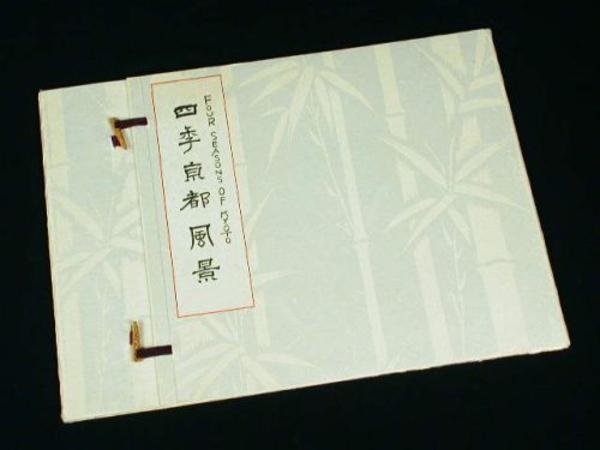
Heian Shrine in the Spring
Woodblock print
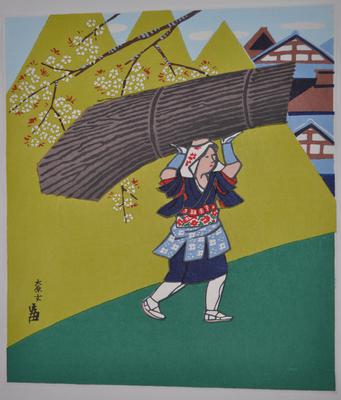
An Oharame Girl Carrying Firewood on Her Head
20th century
Woodblock print, ink and color on paper

April (Arashiyama Park, a Famous Scenic Resort)
四月 (嵐山)
second half 20th century
Woodblock print, ink and color on paper

June (Rainy Scene of the Sen-ke, Japanese Tea Ceremony Founder's House)
六月 (千家雨景)
second half 20th century
Woodblock print, ink and color on paper
More Mount Fuji Prints
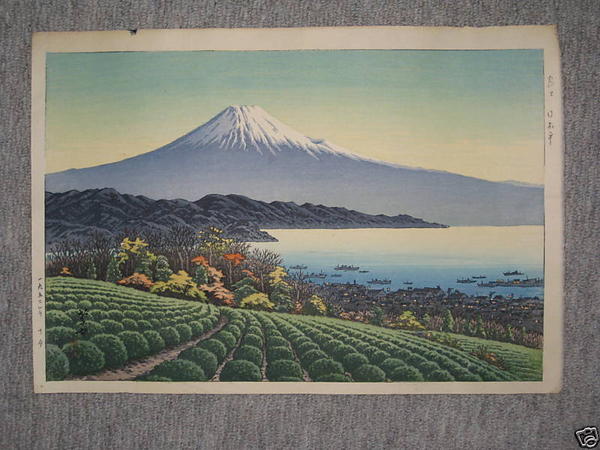
Fuji from tea farm
Woodblock print

Akasaka, Fujikawa, Okazaki, Chiryu, and Narumi, from the series "Famous Places on the Fifty-three Stations of the Tokaido, Five Stations (Tokaido gojusan eki goshuku meisho)"
c. 1830/35
Color woodblock print; oban
![Mount Fuji on a Moonlit Night, Kawai Bridge (Tsukiyo no Fuji [Kawaibashi]), from the series "Selection of Views of the Tokaido (Tokaido fukei senshu)" by Kawase Hasui](https://www.artic.edu/iiif/2/d0960668-1e73-339a-b182-fb995a54bff0/full/843,/0/default.jpg)
Mount Fuji on a Moonlit Night, Kawai Bridge (Tsukiyo no Fuji [Kawaibashi]), from the series "Selection of Views of the Tokaido (Tokaido fukei senshu)"
1947
Color woodblock print; oban

Mt. Fuji in Rain (Ame no Fuji)
n.d.
Color woodblock print
Featured in Collections
Curated cross-cuts that include this print.
Frequently Asked Questions
Mt Fuji was created by Tomikichiro Tokuriki (徳力富吉郎).
Mt Fuji depicts mount fuji.