
Mt Fuji
- Medium:
- Mokuhanga (Japanese woodblock)
- Image courtesy of
- Saru Gallery
Description
A focused study of Mount Fuji presented without the contextual landmarks that anchor more elaborate compositions. Tokuriki produced numerous Fuji prints throughout his seventy-year career, and an unspecified-location view of this kind tends to concentrate on the mountain's silhouette, snow line, and surrounding atmosphere—a particular time of day or season indicated through color choice and the calibrated softness of bokashi gradation. Working in the lineage initiated by Hokusai's Thirty-Six Views and Hiroshige's later Fuji series, Tokuriki updated the meisho-e formula for twentieth-century audiences, using mokuhanga's hand-printed register to deliver chromatic depth difficult to achieve in mechanical reproduction. The unprinted whiteness of the snow cap, achieved by leaving washi bare while surrounding blocks impart their pigment, is itself a compositional device. Such prints functioned both as collectible single sheets and as components of larger thematic series, reflecting the artist's training in the Kyoto craft tradition while serving the postwar tourist and export markets that sustained Japanese woodblock printmaking after the decline of full shin-hanga publishing.
More Prints by Tomikichiro Tokuriki
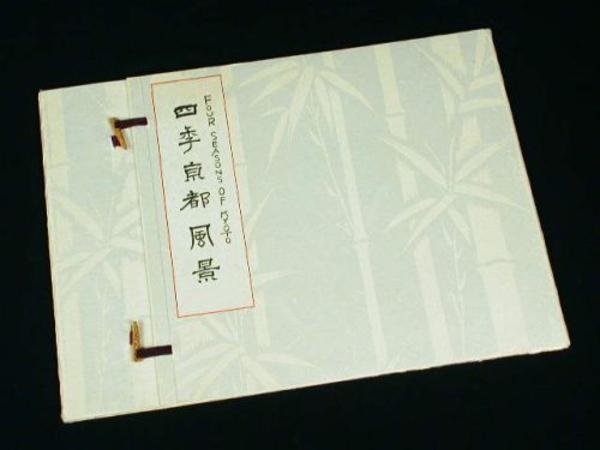
Heian Shrine in the Spring
Woodblock print
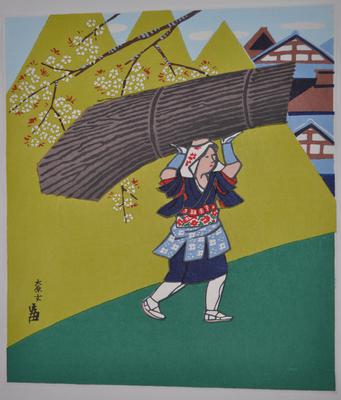
An Oharame Girl Carrying Firewood on Her Head
20th century
Woodblock print, ink and color on paper

April (Arashiyama Park, a Famous Scenic Resort)
四月 (嵐山)
second half 20th century
Woodblock print, ink and color on paper

June (Rainy Scene of the Sen-ke, Japanese Tea Ceremony Founder's House)
六月 (千家雨景)
second half 20th century
Woodblock print, ink and color on paper
More Mount Fuji Prints
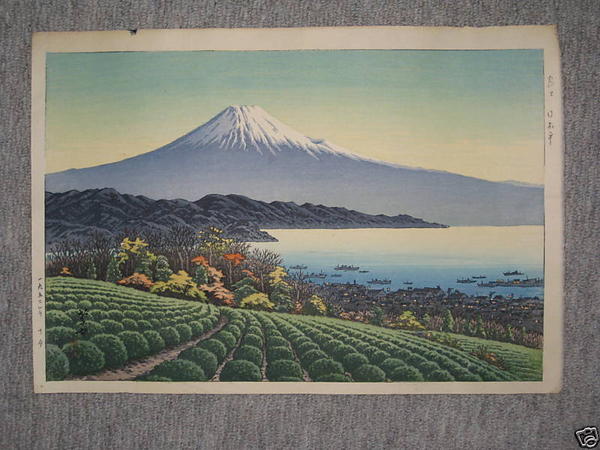
Fuji from tea farm
Woodblock print

Akasaka, Fujikawa, Okazaki, Chiryu, and Narumi, from the series "Famous Places on the Fifty-three Stations of the Tokaido, Five Stations (Tokaido gojusan eki goshuku meisho)"
c. 1830/35
Color woodblock print; oban
![Mount Fuji on a Moonlit Night, Kawai Bridge (Tsukiyo no Fuji [Kawaibashi]), from the series "Selection of Views of the Tokaido (Tokaido fukei senshu)" by Kawase Hasui](https://www.artic.edu/iiif/2/d0960668-1e73-339a-b182-fb995a54bff0/full/843,/0/default.jpg)
Mount Fuji on a Moonlit Night, Kawai Bridge (Tsukiyo no Fuji [Kawaibashi]), from the series "Selection of Views of the Tokaido (Tokaido fukei senshu)"
1947
Color woodblock print; oban

Mt. Fuji in Rain (Ame no Fuji)
n.d.
Color woodblock print
Featured in Collections
Curated cross-cuts that include this print.
Frequently Asked Questions
Mt Fuji was created by Tomikichiro Tokuriki (徳力富吉郎).
Mt Fuji depicts mount fuji.