
Mt Fuji from Tokyo
- Medium:
- Mokuhanga (Japanese woodblock)
- Image courtesy of
- Saru Gallery
Description
Views of Fuji from Tokyo gained particular currency in the early modern period as the city expanded westward and the mountain remained visible on clear days from elevated vantages such as Surugadai, Asakusa, or the heights west of the imperial palace. A Tokuriki print of this type would likely place an urban or suburban foreground — rooftops, telegraph poles, a river or bridge — beneath Fuji's distant silhouette, registering the mountain's persistence within the modernising city. The treatment recalls Hokusai's Thirty-Six Views of Mount Fuji, which similarly framed Fuji through Edo-period Tokyo's labour, leisure, and infrastructure. Tokuriki's twentieth-century version updates the framing for the post-war city, with bokashi softening the haze of distance that increasingly separated viewer from mountain. The composition belongs to the meisho-e tradition but carries an implicit commentary on urban change: Fuji as the constant against which Tokyo's transformation could be measured.
More Prints by Tomikichiro Tokuriki
Heian Shrine in the Spring
Woodblock print
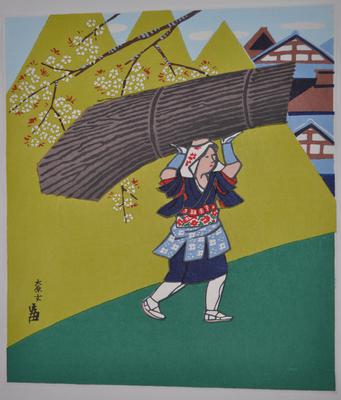
An Oharame Girl Carrying Firewood on Her Head
20th century
Woodblock print, ink and color on paper

April (Arashiyama Park, a Famous Scenic Resort)
四月 (嵐山)
second half 20th century
Woodblock print, ink and color on paper

June (Rainy Scene of the Sen-ke, Japanese Tea Ceremony Founder's House)
六月 (千家雨景)
second half 20th century
Woodblock print, ink and color on paper
More Mount Fuji Prints
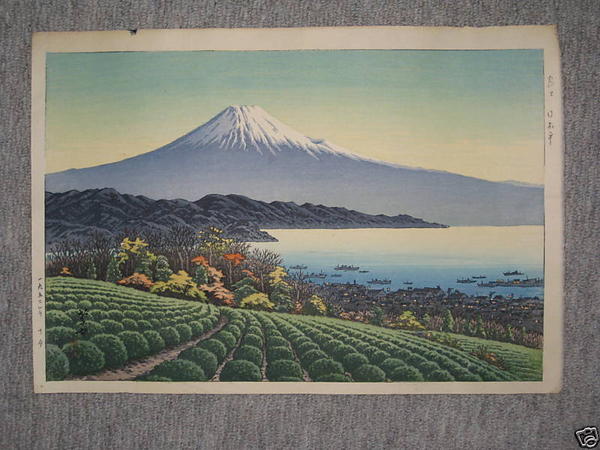
Fuji from tea farm
Woodblock print

Akasaka, Fujikawa, Okazaki, Chiryu, and Narumi, from the series "Famous Places on the Fifty-three Stations of the Tokaido, Five Stations (Tokaido gojusan eki goshuku meisho)"
c. 1830/35
Color woodblock print; oban
![Mount Fuji on a Moonlit Night, Kawai Bridge (Tsukiyo no Fuji [Kawaibashi]), from the series "Selection of Views of the Tokaido (Tokaido fukei senshu)" by Kawase Hasui](https://www.artic.edu/iiif/2/d0960668-1e73-339a-b182-fb995a54bff0/full/843,/0/default.jpg)
Mount Fuji on a Moonlit Night, Kawai Bridge (Tsukiyo no Fuji [Kawaibashi]), from the series "Selection of Views of the Tokaido (Tokaido fukei senshu)"
1947
Color woodblock print; oban

Mt. Fuji in Rain (Ame no Fuji)
n.d.
Color woodblock print
Featured in Collections
Curated cross-cuts that include this print.
Frequently Asked Questions
Mt Fuji from Tokyo was created by Tomikichiro Tokuriki (徳力富吉郎).
Mt Fuji from Tokyo depicts mount fuji.