
Benkei Bridge
- Medium:
- Mokuhanga (Japanese woodblock)
- Image courtesy of
- Saru Gallery
Description
Benkei Bridge depicts the short span at Akasaka-mitsuke that crosses the moat at the southwestern edge of the Imperial Palace grounds, named for the legendary warrior-monk Benkei. Toshi Yoshida's view likely centers on the bridge's stone parapet and lantern posts seen across the still water of the moat, with the green slope of the palace earthworks rising behind. Compositions of this kind rely on a long horizontal format and several blocks of graduated green and grey, with bokashi worked across the water to suggest reflection. The subject belongs to the same Tokyo meisho-e cluster as his Hie-jinja and Ryogoku designs, treating moats, shrines, and bridges as the surviving fabric of the Edo capital absorbed into the modern city. Toshi's handling of the moat scenery extends a theme his father Hiroshi Yoshida had explored in prints of the palace plaza and Sakurada gate, allowing the studio's distinctive printing methods to register the muted palette of central Tokyo's institutional precincts.
More Prints by Toshi Yoshida


More Bridges Prints
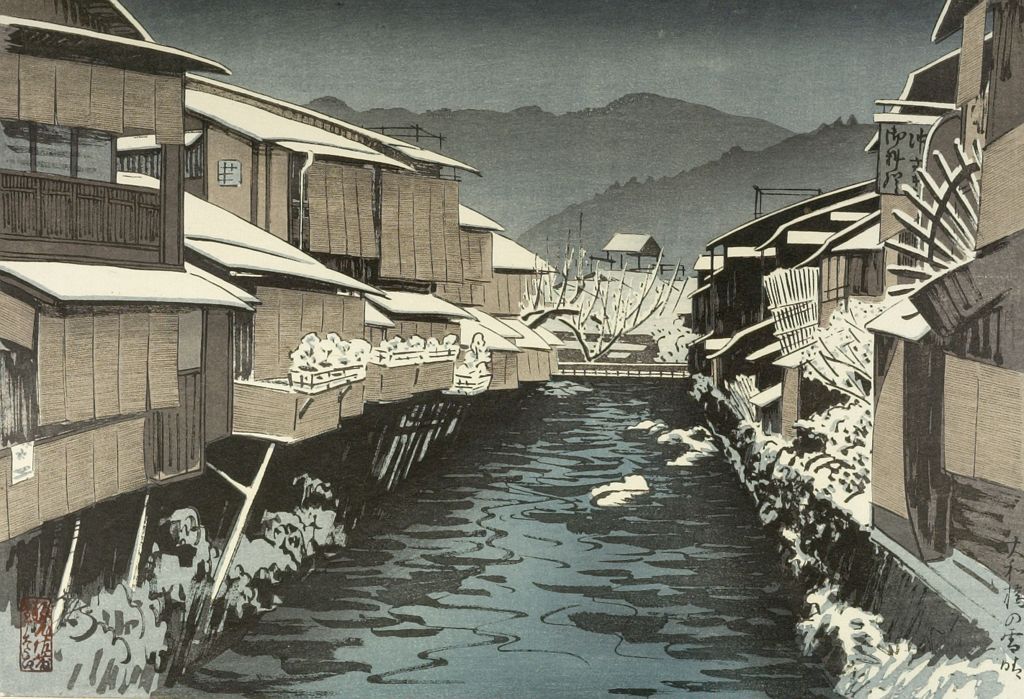
Fair Weather After Snow at Yamato Bridge, Kyoto (Yamato bashi no yukibare), Taishô period, dated 1924
Woodblock print
![Mount Fuji on a Moonlit Night, Kawai Bridge (Tsukiyo no Fuji [Kawaibashi]), from the series "Selection of Views of the Tokaido (Tokaido fukei senshu)" by Kawase Hasui](https://www.artic.edu/iiif/2/d0960668-1e73-339a-b182-fb995a54bff0/full/843,/0/default.jpg)
Mount Fuji on a Moonlit Night, Kawai Bridge (Tsukiyo no Fuji [Kawaibashi]), from the series "Selection of Views of the Tokaido (Tokaido fukei senshu)"
1947
Color woodblock print; oban

Shin Ohashi Bridge (Shin Ohashi), from the series "Twenty View of Tokyo (Tokyu nijukkei)"
1926
Color woodblock print; oban

Sacred Bridge in Nikko (Nikko Shinkyo)
1930
Color woodblock print; oban
Featured in Collections
Curated cross-cuts that include this print.
Frequently Asked Questions
Benkei Bridge was created by Toshi Yoshida (吉田遠志).
Benkei Bridge depicts bridges.