
Hie-jinja Shrine
- Medium:
- Mokuhanga (Japanese woodblock)
- Image courtesy of
- Saru Gallery
Description
Hie-jinja Shrine depicts the Sannō shrine complex in Tokyo's Akasaka district, a Shintō foundation rebuilt after wartime destruction. Toshi Yoshida likely renders the vermillion-lacquered torii gate and tiered roofline against the dense foliage that surrounds the precinct, organizing the composition through the strong verticals of cryptomeria trunks and the horizontal sweep of roof tiles. Prints of this kind from the mid-twentieth-century shin-hanga lineage typically rely on careful key-block registration and graduated bokashi to model masonry steps and tile shadow, with the cinnabar lacquer pulled from a separate block to keep its saturation. The subject sits within the meisho-e tradition of famous-place views, a category his father Hiroshi Yoshida had reframed for a modern audience through prints such as the Twelve Scenes of Tokyo. Toshi continued this lineage in his own Tokyo views, producing temple and shrine designs that record familiar civic landmarks while attending to the seasonal palette and atmospheric distance that distinguished the Yoshida studio's house style.
More Prints by Toshi Yoshida


More Temples & Shrines Prints
Fushimi Inari Temple
伏見稲荷
Woodblock print

The Compound of the Tenman Shrine at Kameido in the Snow (Kameido Tenmangu keidai no yuki), from the series "Famous Places in the Eastern Capital (Toto meisho)"
c. 1832/38
Color woodblock print; oban
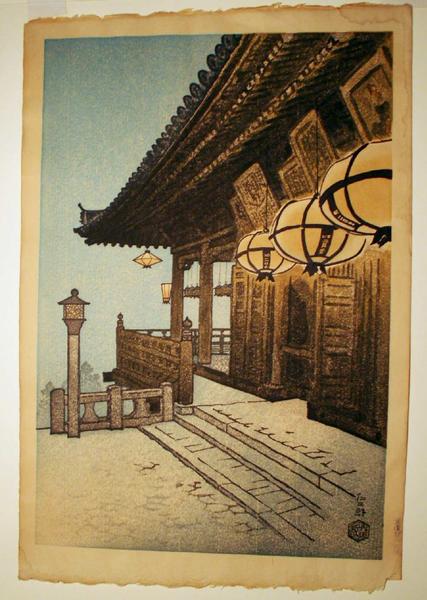
Temple with lanterns
Woodblock print

A Section of the Byodo Temple at Uji (Uji Byodoin no ichibu), from the series "Souvenirs of Travel, Second Series (Tabi miyage dai nishu)"
Uji Byodoin no ichibu
1921
Color woodblock print; oban
Featured in Collections
Curated cross-cuts that include this print.
Frequently Asked Questions
Hie-jinja Shrine was created by Toshi Yoshida (吉田遠志).
Hie-jinja Shrine depicts temples & shrines.