
Ryogoku Bridge
- Medium:
- Mokuhanga (Japanese woodblock)
- Image courtesy of
- Saru Gallery
Description
Ryogoku Bridge depicts the steel-truss span across the Sumida River in eastern Tokyo, a crossing that had been a celebrated subject since Hokusai and Hiroshige treated its earlier wooden incarnations. Toshi Yoshida likely organizes the composition around the bridge's diagonal recession, with river barges, low embankments, and the silhouette of the opposing bank establishing depth. Mid-century woodblock views of Sumida bridges typically use bokashi gradations to render the river's reflective surface and the soft atmospheric haze that distinguishes the Tokyo lowlands, with the iron structure cut as a tightly registered key-block to preserve its rivets and lattice work. The print continues the meisho-e tradition that the Yoshida studio absorbed and modernized: where Hiroshige had shown fireworks and pleasure boats at Ryogoku, Toshi records the industrial bridge as a working civic structure. The subject sits within his Tokyo views series, alongside the Hie-jinja and Benkei Bridge designs, which together document the post-Edo capital through specific architectural landmarks rather than generalized scenery.
More Prints by Toshi Yoshida


More Bridges Prints
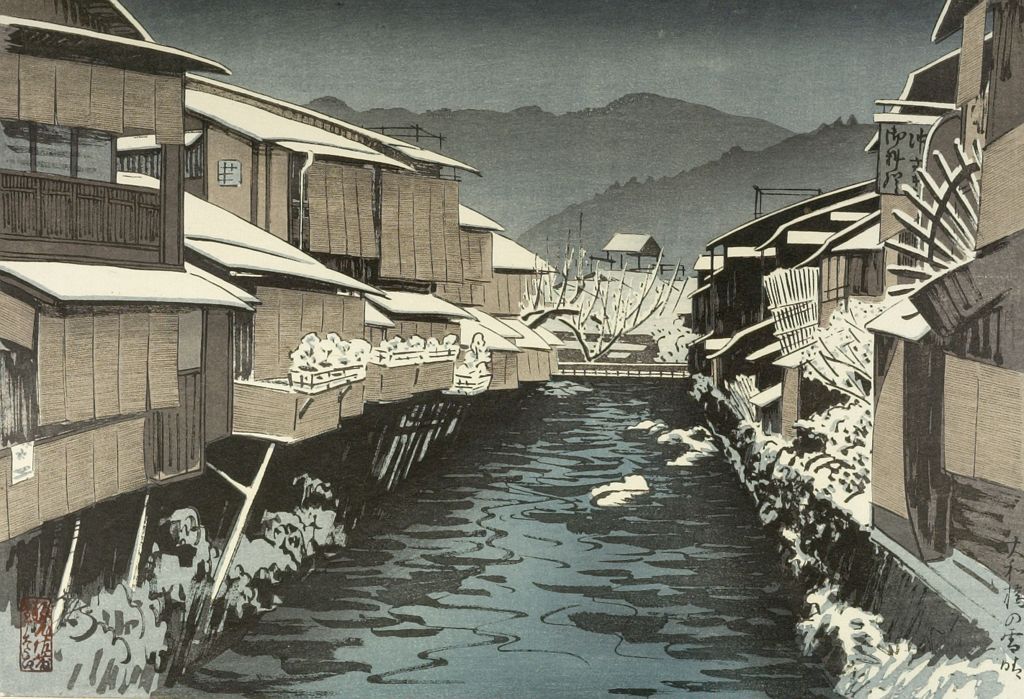
Fair Weather After Snow at Yamato Bridge, Kyoto (Yamato bashi no yukibare), Taishô period, dated 1924
Woodblock print
![Mount Fuji on a Moonlit Night, Kawai Bridge (Tsukiyo no Fuji [Kawaibashi]), from the series "Selection of Views of the Tokaido (Tokaido fukei senshu)" by Kawase Hasui](https://www.artic.edu/iiif/2/d0960668-1e73-339a-b182-fb995a54bff0/full/843,/0/default.jpg)
Mount Fuji on a Moonlit Night, Kawai Bridge (Tsukiyo no Fuji [Kawaibashi]), from the series "Selection of Views of the Tokaido (Tokaido fukei senshu)"
1947
Color woodblock print; oban

Shin Ohashi Bridge (Shin Ohashi), from the series "Twenty View of Tokyo (Tokyu nijukkei)"
1926
Color woodblock print; oban

Sacred Bridge in Nikko (Nikko Shinkyo)
1930
Color woodblock print; oban
Featured in Collections
Curated cross-cuts that include this print.
Frequently Asked Questions
Ryogoku Bridge was created by Toshi Yoshida (吉田遠志).
Ryogoku Bridge depicts bridges.