
Snow Country
- Medium:
- Mokuhanga (Japanese woodblock)
- Image courtesy of
- Saru Gallery
Description
The title evokes Japan's deep-snow regions along the Sea of Japan coast — Niigata, Akita, Yamagata — known in literature through Yasunari Kawabata's novel Yukiguni. Compositions under this name typically render thatched farmhouses, drift-laden rooftops, or village paths half-buried under accumulated snow. Mokuhanga snow scenes in the shin-hanga and sosaku-hanga traditions rely on the unprinted whiteness of the washi sheet itself, with sumi or indigo blocks carrying the structural drawing. Bokashi gradations on grey or violet skies establish dimming winter light. Toshi's snow imagery draws on the foundation laid by his father Hiroshi and contemporaries like Kawase Hasui, who codified the visual vocabulary of Japanese winter landscape during the early Showa period. Within Toshi's broader catalogue — which includes African wildlife and abstract experiments — these traditional subjects mark his fidelity to the Yoshida studio's atmospheric landscape program.
More Prints by Toshi Yoshida


More Snow Scenes Prints
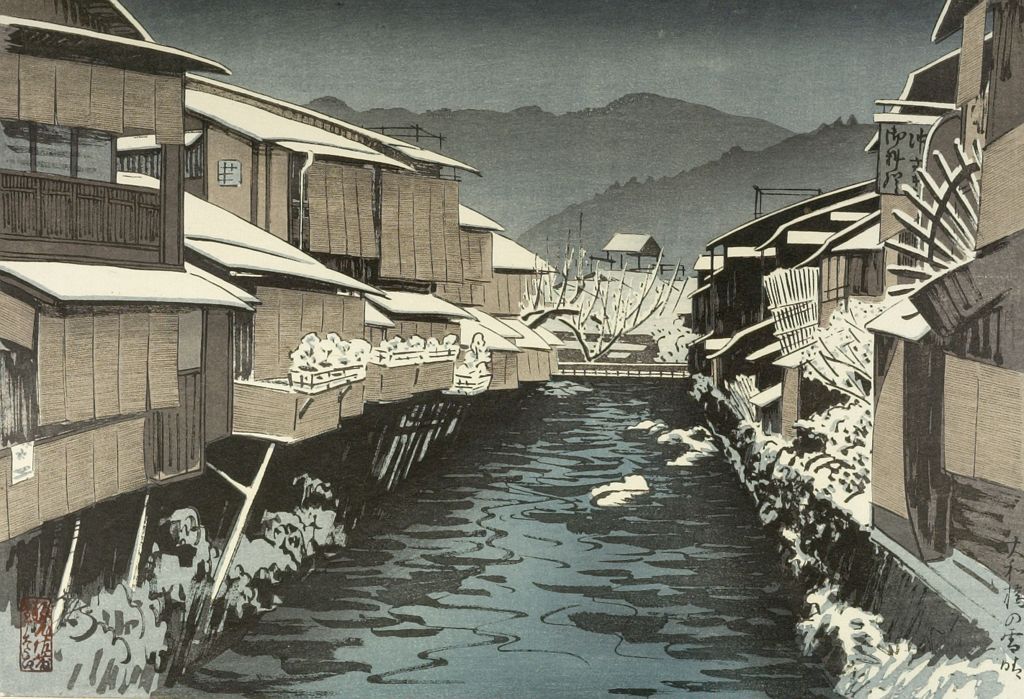
Fair Weather After Snow at Yamato Bridge, Kyoto (Yamato bashi no yukibare), Taishô period, dated 1924
Woodblock print

The Compound of the Tenman Shrine at Kameido in the Snow (Kameido Tenmangu keidai no yuki), from the series "Famous Places in the Eastern Capital (Toto meisho)"
c. 1832/38
Color woodblock print; oban

Miyajima in Snow (Yuki no Miyajima)
Yuki no Miyajima
1929
Color woodblock print; oban
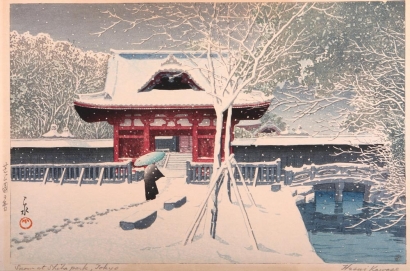
Evening Snow at Shiha Park, Tokyo
1932
Woodblock print
Featured in Collections
Curated cross-cuts that include this print.
Frequently Asked Questions
Snow Country was created by Toshi Yoshida (吉田遠志).
Snow Country depicts snow scenes.