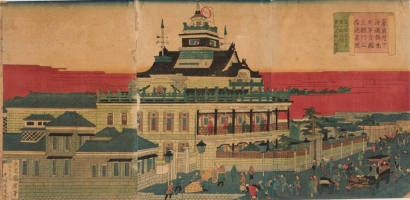
True Picture of a Five-Story Building at Kaiun Bridge (Mitsui House), First National Bank of Japan
海運橋三井組ハウス第一国立銀行真景之図
- Date:
- 1872
- Medium:
- Color woodblock print (nishiki-e), ōban triptych
- Source:
- Art Gallery of Greater Victoria
Description
This 1872 ōban color woodblock triptych by Utagawa Kuniteru II, held by the Art Gallery of Greater Victoria (accession aggv-17004), depicts the five-story Mitsui House at Kaiun Bridge that briefly housed the First National Bank of Japan (Daiichi Kokuritsu Ginkō) from its founding in 1873. The building, designed by the American architect Thomas Waters in the European Renaissance Revival style and built by the Japanese master carpenter Shimizu Kisuke II's firm, was the largest Western-style structure in early-Meiji Tokyo and a defining visual emblem of the modernization program.
The AGGV impression complements the Edo-Tokyo Museum's parallel composition (accession 0188208038) of the same building, recorded in the broader cycle of Kuniteru II's Meiji kaika-e. The two impressions together document the wide commercial circulation of the print across the early-Meiji Tokyo market and the survival of multiple impressions in museum collections — one in Japan and one in Canada — that have preserved the visual record of the building's brief but iconic existence.
The AGGV's caption describes the composition as 'a panorama view in three sections of a large building with a street scene in the foreground depicting people, horse-drawn carriage, rickshaw, lantern posts.' The visual repertoire — the elaborate brick façade, the horse-drawn carriages, the rickshaws, the gas lamps, and the figures in mixed Western-Japanese dress — is the standard kaika-e vocabulary of the early-Meiji period. The Mitsui House (later the First National Bank) stood as a singular visual icon of the new commercial and financial infrastructure that the Meiji government was building in central Tokyo, and Kuniteru II's triptych is among the principal contemporary print records of that structure.
More Prints by Utagawa Kuniteru II

At Nihonbashi, Starting the Ōyama Pilgrimage (Nihonbashi Ōyama mōde no zu)
日本橋大山詣之図
mid-Meiji, ca. 1872
Color woodblock print (nishiki-e), ōban triptych
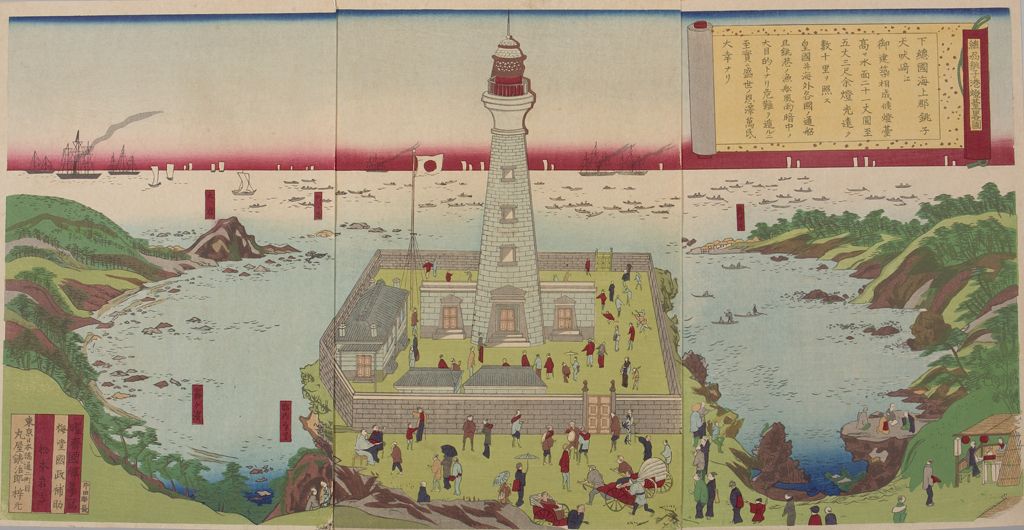
Harbor with Lighthouse and American Men and Ships
Meiji period, late 19th century
Color woodblock print (nishiki-e), ōban triptych
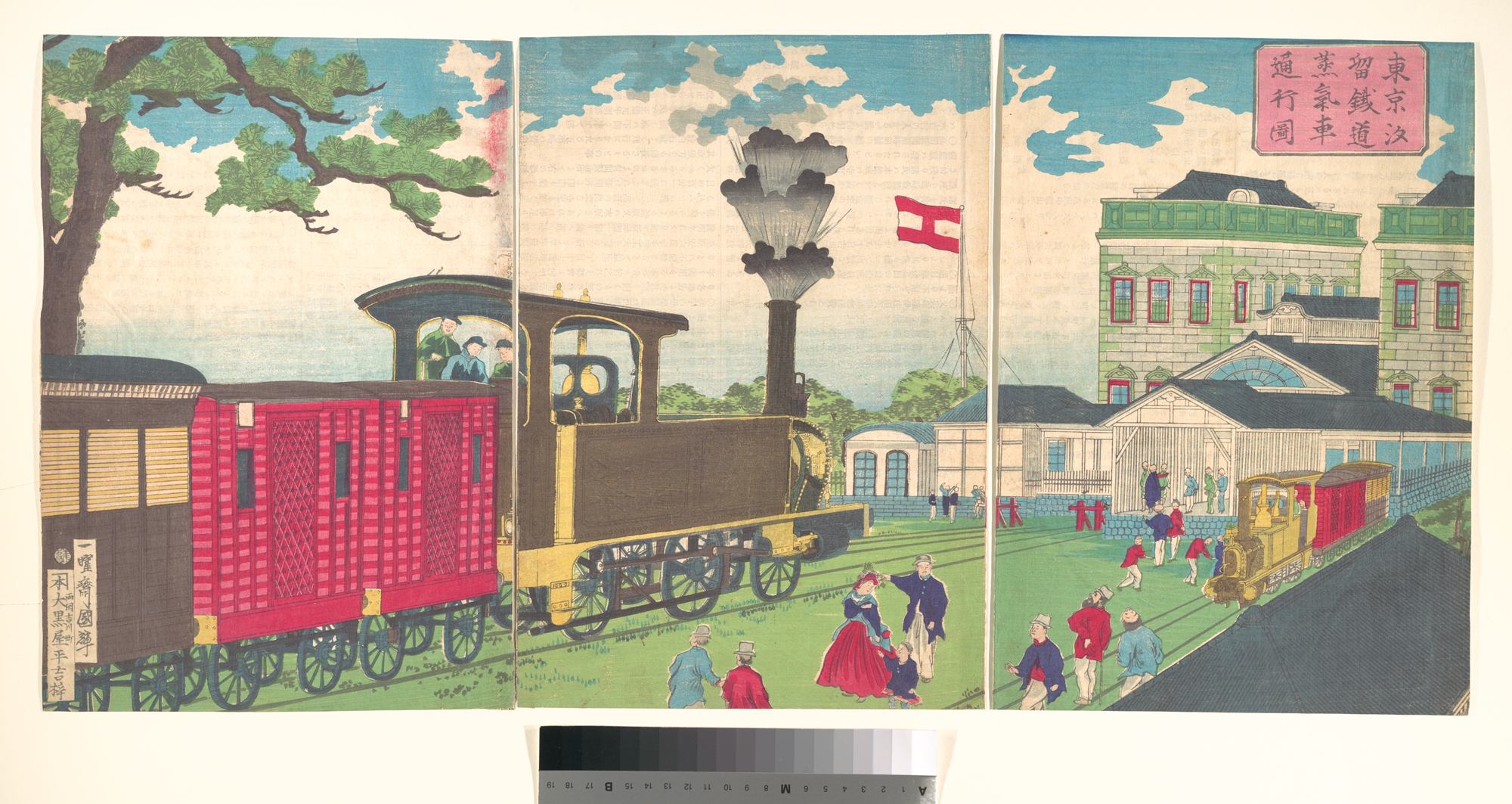
Steam Train Passing Shiodome in Tokyo (Tōkyō Shiodome o tōru jōki kikansha)
東京汐留を通る蒸気機関車
1872
Color woodblock print (nishiki-e), ōban triptych
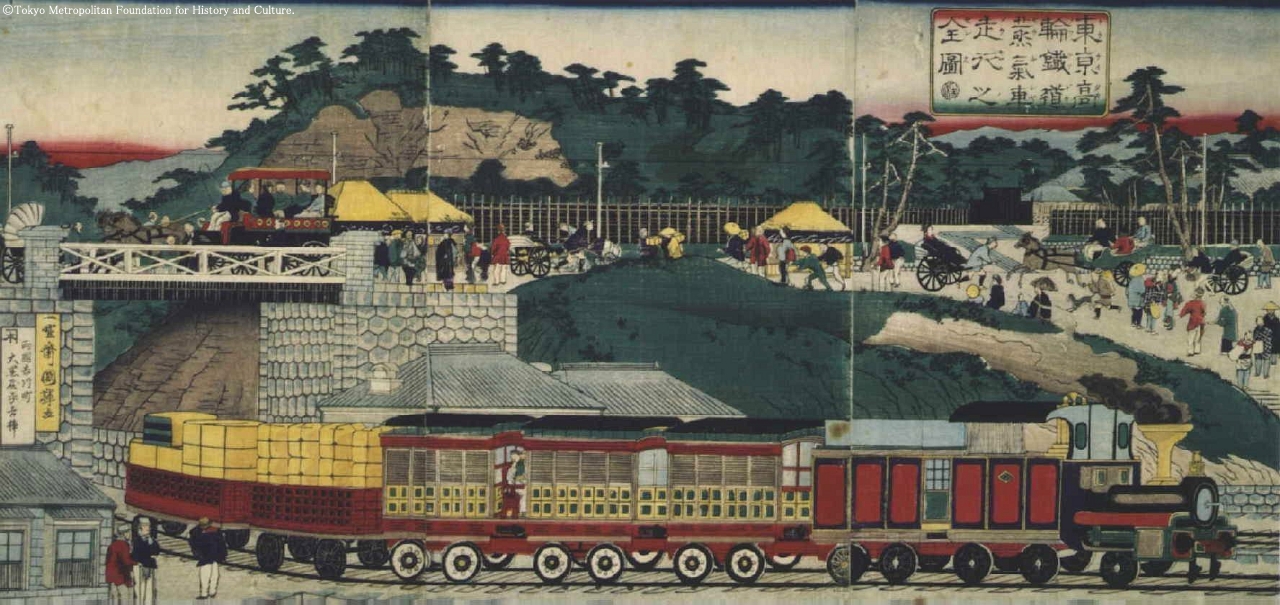
The Takanawa Steam Railway, Tokyo (Tōkyō Takanawa jōki tetsudō)
東京高輪蒸気鉄道
1872
Color woodblock print (nishiki-e), ōban triptych
More Bridges Prints
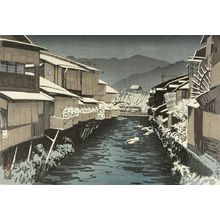
Fair Weather After Snow at Yamato Bridge, Kyoto (Yamato bashi no yukibare), Taishô period, dated 1924
Woodblock print
![Mount Fuji on a Moonlit Night, Kawai Bridge (Tsukiyo no Fuji [Kawaibashi]), from the series "Selection of Views of the Tokaido (Tokaido fukei senshu)" by Kawase Hasui](https://www.artic.edu/iiif/2/d0960668-1e73-339a-b182-fb995a54bff0/full/843,/0/default.jpg)
Mount Fuji on a Moonlit Night, Kawai Bridge (Tsukiyo no Fuji [Kawaibashi]), from the series "Selection of Views of the Tokaido (Tokaido fukei senshu)"
1947
Color woodblock print; oban

Shin Ohashi Bridge (Shin Ohashi), from the series "Twenty View of Tokyo (Tokyu nijukkei)"
1926
Color woodblock print; oban

Sacred Bridge in Nikko (Nikko Shinkyo)
1930
Color woodblock print; oban
Frequently Asked Questions
True Picture of a Five-Story Building at Kaiun Bridge (Mitsui House), First National Bank of Japan (海運橋三井組ハウス第一国立銀行真景之図) was created by Utagawa Kuniteru II (二代歌川国輝) in 1872.
True Picture of a Five-Story Building at Kaiun Bridge (Mitsui House), First National Bank of Japan depicts bridges.