
Double bridge at the imperial palace
by Wada Sanzo
- Medium:
- Mokuhanga (Japanese woodblock)
- Image courtesy of
- Saru Gallery
Description
Double Bridge at the Imperial Palace depicts Nijūbashi, the stone-arched bridge spanning the inner moat at the main entrance to the Kōkyo in Tokyo. Unusually for Wada Sanzo, whose Shōwa Shokugyō Emaki series concentrated on figures and occupations, this sheet is a meisho-e: a famous-place view. The composition almost certainly centers on the twin arches mirrored in the moat water, with the wooded palace embankment and a guard turret beyond. Wada renders the architecture as flat planes of stone gray and water indigo, with the keyblock supplying clean structural outlines rather than tonal modeling — a treatment that owes more to his yōga design sensibility than to the atmospheric bokashi gradients favored by shin-hanga landscape printmakers such as Hasui or Yoshida. The print extends the Edo meisho-e tradition, in which Hiroshige and others had recorded Edo Castle's outer precincts, into a Shōwa civic register, presenting Nijūbashi as a national symbol rendered in the same graphic vocabulary Wada applied to working figures.
More Prints by Wada Sanzo
More Bridges Prints
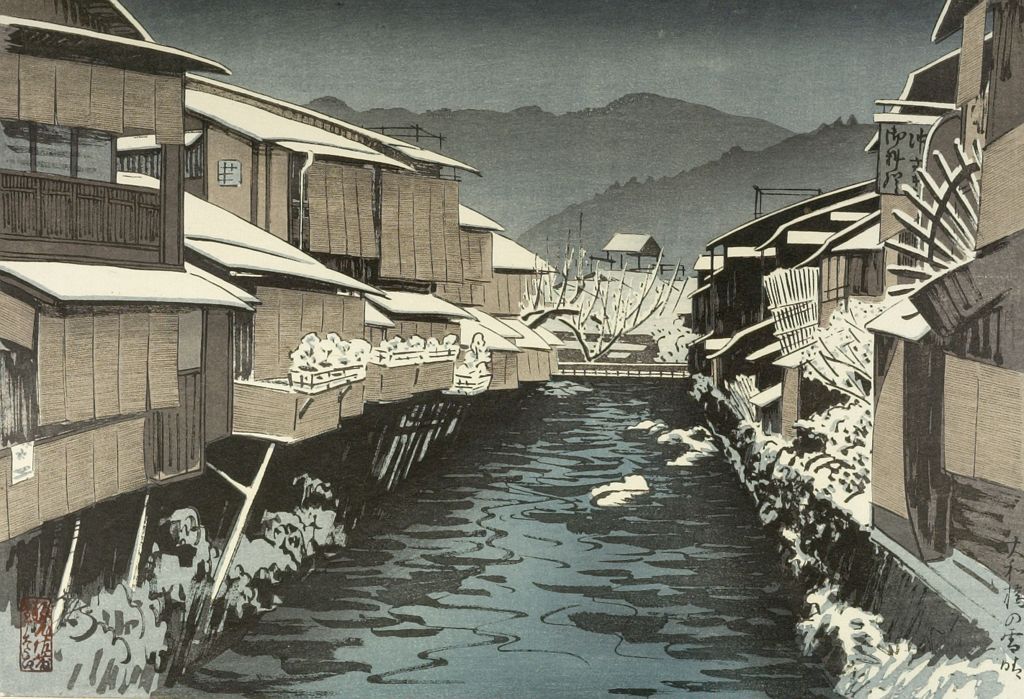
Fair Weather After Snow at Yamato Bridge, Kyoto (Yamato bashi no yukibare), Taishô period, dated 1924
Woodblock print
![Mount Fuji on a Moonlit Night, Kawai Bridge (Tsukiyo no Fuji [Kawaibashi]), from the series "Selection of Views of the Tokaido (Tokaido fukei senshu)" by Kawase Hasui](https://www.artic.edu/iiif/2/d0960668-1e73-339a-b182-fb995a54bff0/full/843,/0/default.jpg)
Mount Fuji on a Moonlit Night, Kawai Bridge (Tsukiyo no Fuji [Kawaibashi]), from the series "Selection of Views of the Tokaido (Tokaido fukei senshu)"
1947
Color woodblock print; oban

Shin Ohashi Bridge (Shin Ohashi), from the series "Twenty View of Tokyo (Tokyu nijukkei)"
1926
Color woodblock print; oban

Sacred Bridge in Nikko (Nikko Shinkyo)
1930
Color woodblock print; oban
Featured in Collections
Curated cross-cuts that include this print.
Frequently Asked Questions
Double bridge at the imperial palace was created by Wada Sanzo (和田三造).
Double bridge at the imperial palace depicts bridges.