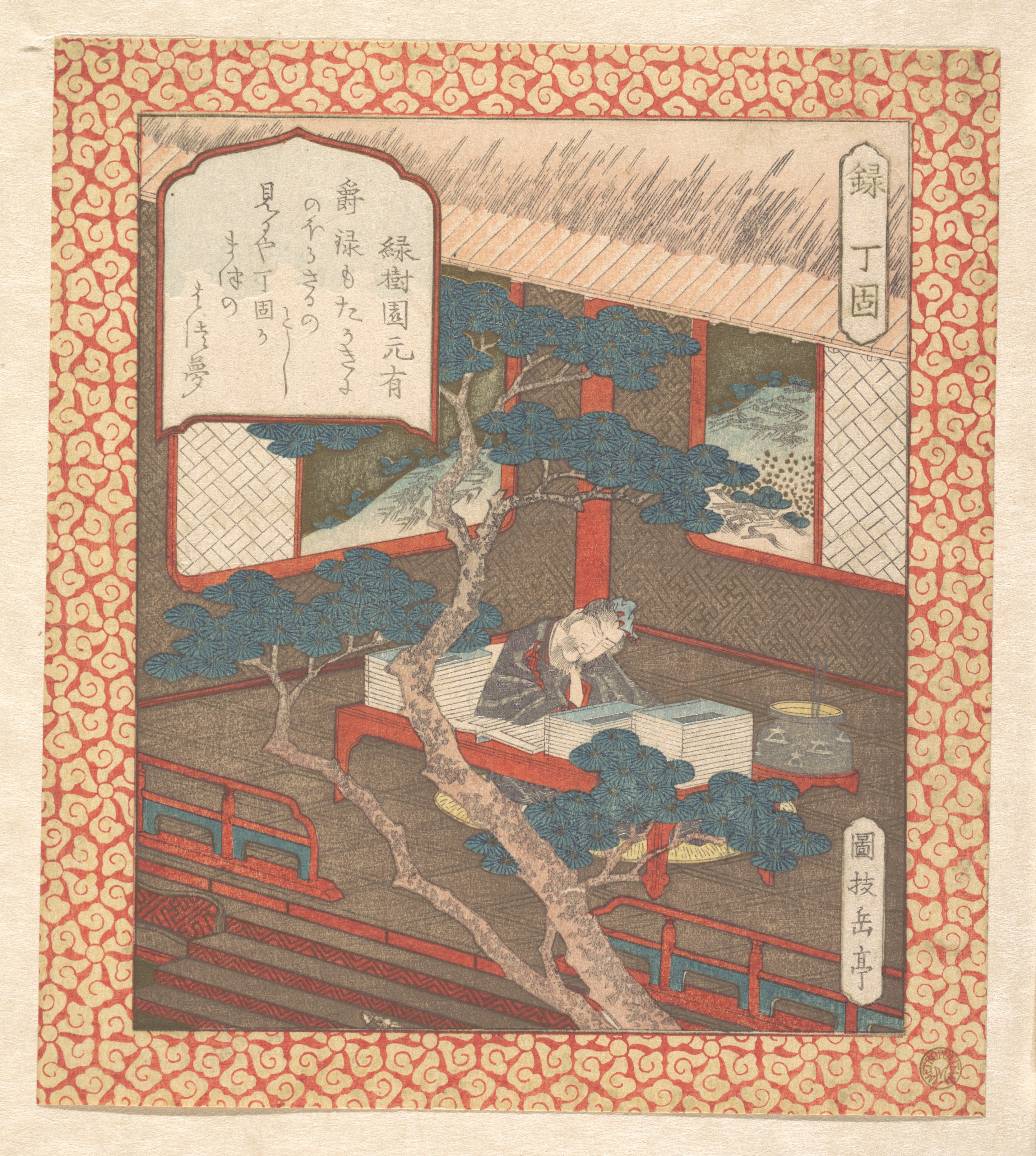
A Sage Fallen Asleep Over His Books
- Date:
- ca. 1820
- Medium:
- Woodblock print (surimono); ink and color on paper
- Source:
- Metropolitan Museum of Art
Description
Yashima Gakutei's A Sage Fallen Asleep Over His Books, in the Metropolitan Museum of Art, captures a quietly humorous moment of intellectual exhaustion. A Chinese-style scholar has nodded off amid his volumes, head bowed or resting against a hand, books and scrolls spread around him. The motif belongs to a long East Asian tradition of literati imagery, in which the scholar's study is depicted as both the site of profound learning and, occasionally, of comfortable lapse. Gakutei treats the subject with affectionate restraint, balancing reverence for scholarship with gentle wit. Yashima Gakutei was a prominent designer within the Hokusai school, having trained under Totoya Hokkei and absorbed the wider influence of Katsushika Hokusai. He was renowned for surimono produced for kyoka poetry circles in Osaka and Edo, but he also designed illustrated books and standalone prints with Chinese literary themes, ranging from heroes of the Three Kingdoms to recluses, immortals, and bookish sages. In a print of this kind he could display his command of compositional rhythm: stacks of books, drapery folds, and the quiet curve of the dozing figure are all arranged so that small details reward careful inspection. The subject also carried discreet meaning for kyoka audiences. Members of poetry circles, themselves often serious students of Chinese and Japanese classics, could read the image as an affectionate self-portrait, acknowledging the gap between scholarly aspiration and the realities of long evenings with one's books. Surimono enhanced the conceit with luxurious materials and finely calibrated printing. The Metropolitan Museum of Art preserves this Yashima Gakutei design as a representative example of his witty literati subjects.
More Prints by Yashima Gakutei


More Autumn Foliage Prints

A Farmhouse in Autumn, Ayashi, Miyagi Prefecture (Noka no aki (Miyagi ken Ayashi)
Noka no aki (Miyagi ken Ayashi
1946
Color woodblock print
Yoro Waterfall in Mino Province (Mino no kuni Yoro no taki), from the series Tour of the Waterfalls in Various Provinces (Shokoku Takimeguri)
Woodblock print

Tengui Rock, Autumn in Shiobara (Shiobara no aki (Tenguiwa))
1950
Color woodblock print

Autumn at the Arayu Hot Spring, Shiobara
Autumn 1920
Woodblock print, ink and color on paper
Frequently Asked Questions
A Sage Fallen Asleep Over His Books was created by Yashima Gakutei (八島岳亭) in ca. 1820.
A Sage Fallen Asleep Over His Books depicts autumn foliage.