
Mt. Fuji and Pine Tree
- Date:
- 19th century
- Medium:
- Color woodblock print in six-fold manner
- Source:
- Art Institute of Chicago
Description
This nineteenth-century woodblock print, identified at the Art Institute of Chicago as Mt. Fuji and Pine Tree, is described in the museum's catalogue as a color woodblock print in six-fold manner, a notation indicating an unusual format that may relate to surimono or album leaves bound for poetic circulation. The composition juxtaposes the iconic silhouette of Fuji with a flanking pine, a pairing that draws on classical waka and kyoka conventions in which the pine signifies longevity and the mountain serves as the cosmic anchor of Japan. Gakutei's training in the Hokusai school is evident in the linear clarity of the mountain's slopes and the disciplined needling of the pine boughs, while his surimono sensibility appears in the restrained palette and the careful balance of negative space. Pictured among Gakutei's broader landscape output, the design anticipates his celebrated Tenpozan and Yodogawa series and demonstrates how the kyoka-e tradition channeled landscape motifs through the dual lens of poetic allusion and visual economy.
More Prints by Yashima Gakutei


More Mount Fuji Prints
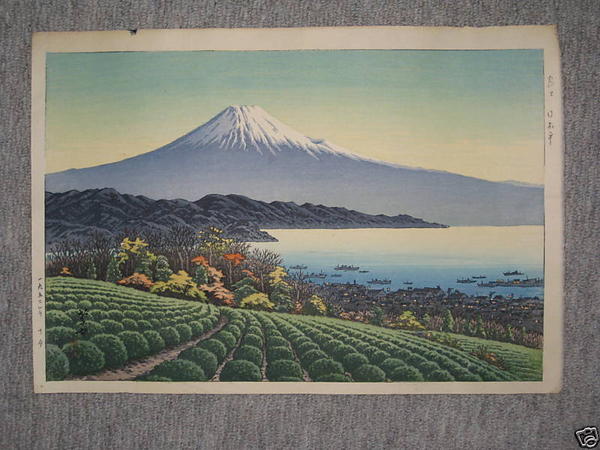
Fuji from tea farm
Woodblock print

Akasaka, Fujikawa, Okazaki, Chiryu, and Narumi, from the series "Famous Places on the Fifty-three Stations of the Tokaido, Five Stations (Tokaido gojusan eki goshuku meisho)"
c. 1830/35
Color woodblock print; oban
![Mount Fuji on a Moonlit Night, Kawai Bridge (Tsukiyo no Fuji [Kawaibashi]), from the series "Selection of Views of the Tokaido (Tokaido fukei senshu)" by Kawase Hasui](https://www.artic.edu/iiif/2/d0960668-1e73-339a-b182-fb995a54bff0/full/843,/0/default.jpg)
Mount Fuji on a Moonlit Night, Kawai Bridge (Tsukiyo no Fuji [Kawaibashi]), from the series "Selection of Views of the Tokaido (Tokaido fukei senshu)"
1947
Color woodblock print; oban

Mt. Fuji in Rain (Ame no Fuji)
n.d.
Color woodblock print
Featured in Collections
Curated cross-cuts that include this print.
Frequently Asked Questions
Mt. Fuji and Pine Tree was created by Yashima Gakutei (八島岳亭) in 19th century.
Mt. Fuji and Pine Tree depicts mount fuji.