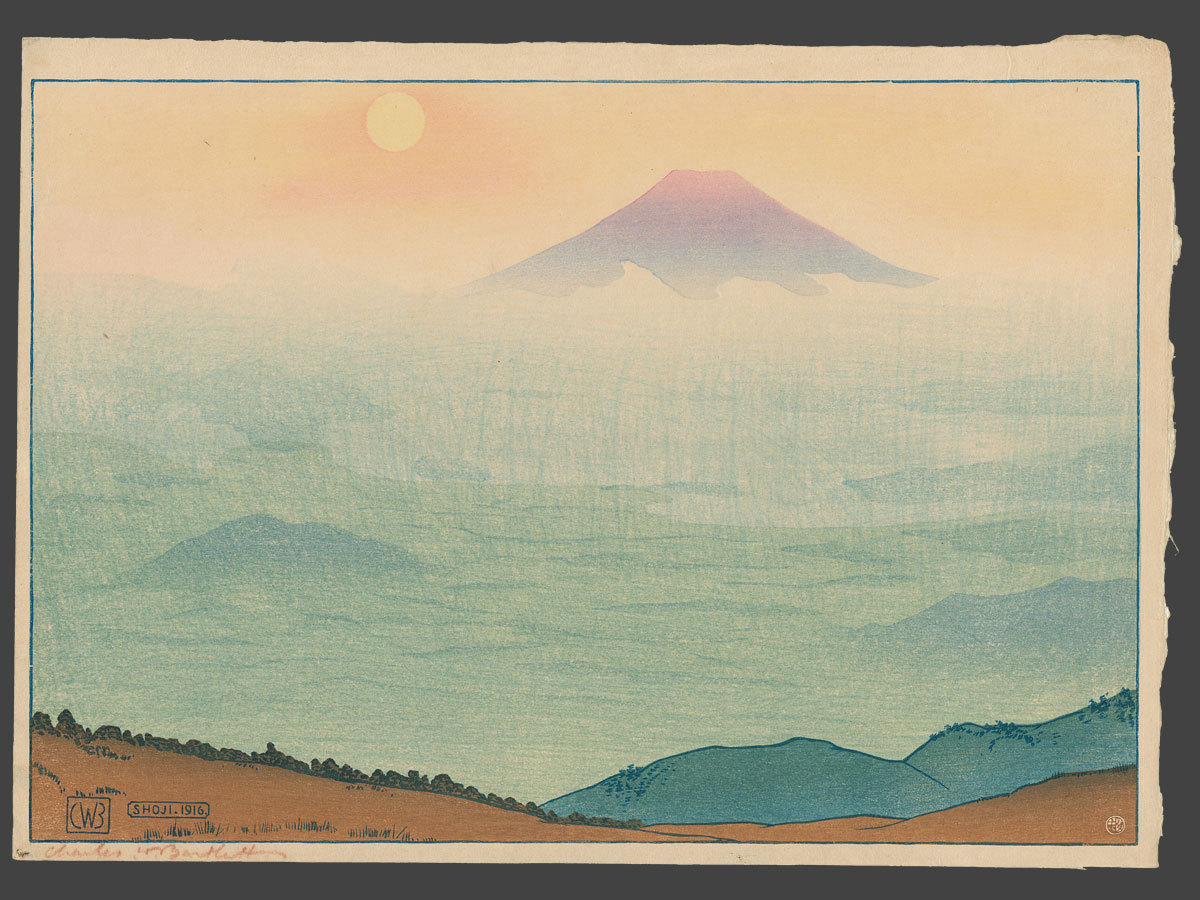
Shoji
- Date:
- 1916
- Medium:
- Woodblock print
- Format:
- Oban
- Source:
- Art of Japan
Description
Shoji, created in 1916, takes as its subject the translucent sliding paper screens that are one of the most distinctive elements of Japanese interior architecture. Shoji, made from washi paper stretched over a wooden lattice frame, filter exterior light into a soft, diffused glow that fills Japanese rooms with an even, shadowless illumination. The screens also create flexible spatial divisions, allowing rooms to be opened, closed, or reconfigured according to need.
Bartlett's oban woodblock print captures the quality of light transmitted through shoji, a phenomenon that fascinated many Western visitors to Japan. The warm glow of paper-filtered daylight, the geometric grid of the wooden lattice visible in silhouette, and the suggestion of garden or exterior space beyond the screen create a composition centered on the experience of interior space. As a Western artist working in a Japanese medium, Bartlett's attention to this quintessentially Japanese architectural element reflects his genuine engagement with the culture whose printmaking technique he had adopted.
More Prints by Charles W. Bartlett

More Interiors Prints



Featured in Collections
Curated cross-cuts that include this print.
Frequently Asked Questions
Shoji was created by Charles W. Bartlett in 1916.
Shoji depicts interiors.