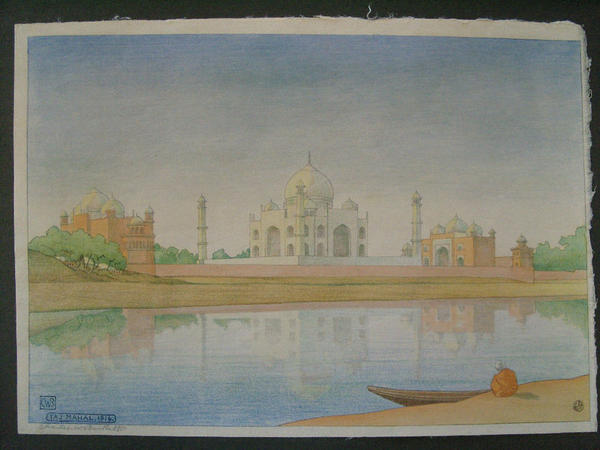
Taj Mahal at Dawn
- Date:
- 1916
- Medium:
- Drawing
- Source:
- Japanese Art Open Database
Description
Taj Mahal at Dawn, created in 1916, records the first light of day striking the Mughal emperor Shah Jahan's seventeenth-century marble mausoleum in Agra. Dawn is the most celebrated moment to view the Taj Mahal, when the white Makrana marble absorbs the changing colors of the rising sun, shifting from gray-blue to pink to gold to blazing white within the span of an hour.
This drawing captures Bartlett's direct response to this transformative light event, recording the specific tonal relationships he observed before the scene could be formalized into a woodblock composition. The drawing medium allowed Bartlett to work rapidly as the light changed, noting the proportional relationships of the monument's dome, minarets, and reflecting pool while the atmospheric conditions remained favorable. Bartlett produced multiple works of the Taj Mahal across different media and lighting conditions, reflecting the building's inexhaustible visual richness and its central place in his Indian body of work.
More Prints by Charles W. Bartlett

More Religious Prints

The Great Buddha, Kamakura (Kamakura Daibutsu)
Kamakura Daibutsu
1930
Color woodblock print

Hall of the Great Buddha (Nara Daibutsuden)
1950
Color woodblock print
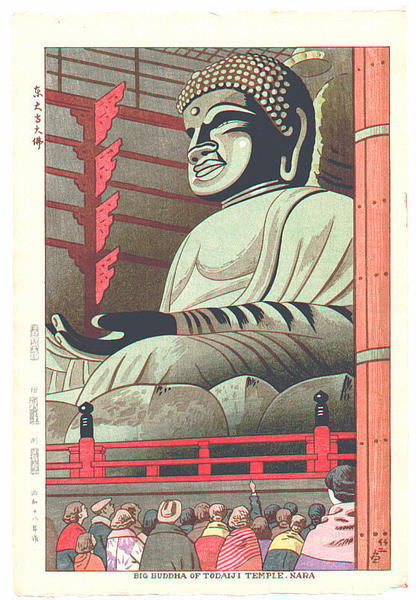
Great Buddha
大仏
Woodblock print

Clearing after a Snowfall at the Kannon Temple in Asakusa (Asakusa Kannon no yukibare), from the series "Twenty Views of Tokyo (Tokyo nijukkei)"
1926
Color woodblock print; oban
Featured in Collections
Curated cross-cuts that include this print.
Frequently Asked Questions
Taj Mahal at Dawn was created by Charles W. Bartlett in 1916.
Taj Mahal at Dawn depicts religious, night scenes, and architecture.