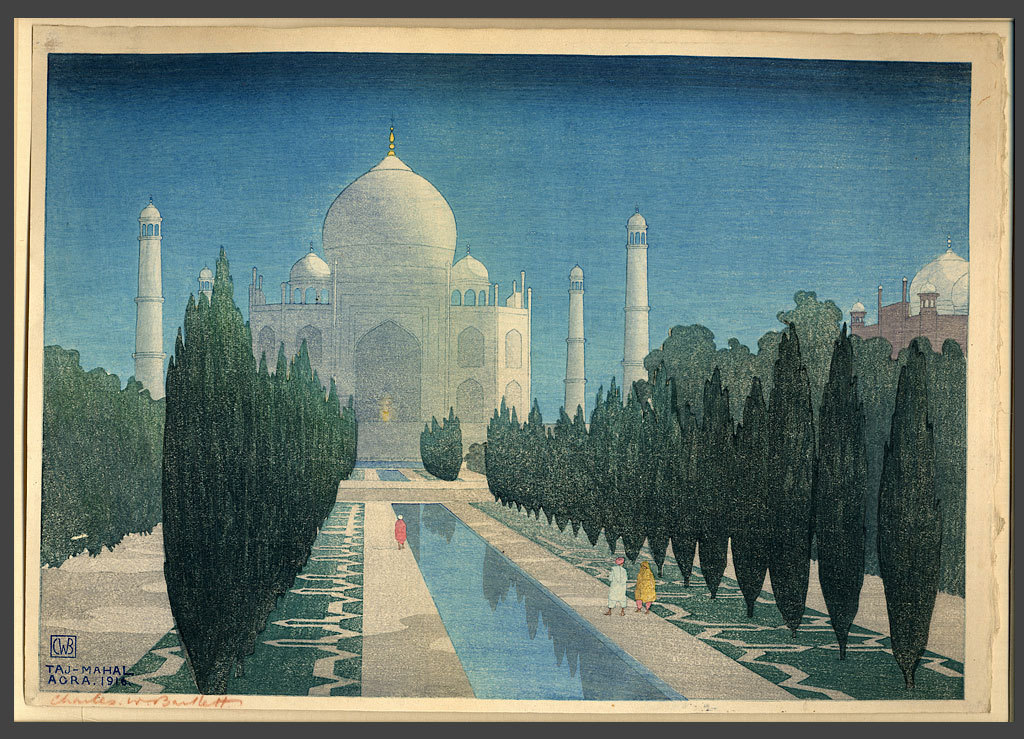
Taj Mahal by Moonlight
- Date:
- 1916
- Medium:
- Woodblock print
- Format:
- Oban
- Source:
- Art of Japan
Description
Taj Mahal by Moonlight, created in 1916, presents Shah Jahan's marble mausoleum under the conditions that many regard as its most magical: bathed in the silvery blue light of a full moon, with the white marble glowing against the dark sky and the still water of the reflecting pool creating a perfect doubled image. Moonlit viewing of the Taj Mahal was a tradition that predated tourism, originating with the Mughal court itself.
Bartlett's oban woodblock print exploits the medium's exceptional capacity for rendering nocturnal atmosphere. The bokashi shading technique, where pigment is graduated across the block's surface, allows the printer to create smooth transitions from the deep indigo of the night sky to the pale luminosity of moonlit marble. The monochromatic palette of blues, silvers, and whites reduces the Taj Mahal to its essential forms, the great dome, the flanking minarets, the long reflecting channel, all rendered as shapes of light against the surrounding darkness. This is among Bartlett's most technically accomplished prints.
More Prints by Charles W. Bartlett

More Moonlight Prints
![Mount Fuji on a Moonlit Night, Kawai Bridge (Tsukiyo no Fuji [Kawaibashi]), from the series "Selection of Views of the Tokaido (Tokaido fukei senshu)" by Kawase Hasui](https://www.artic.edu/iiif/2/d0960668-1e73-339a-b182-fb995a54bff0/full/843,/0/default.jpg)
Mount Fuji on a Moonlit Night, Kawai Bridge (Tsukiyo no Fuji [Kawaibashi]), from the series "Selection of Views of the Tokaido (Tokaido fukei senshu)"
1947
Color woodblock print; oban

Evening Moon at Nakanoshima, Sapporo (Sapporo Nakanoshima no yuzuki), from the series "Collection of Views of Japan, Eastern Japan Edition (Nihon fukei shu higashi Nihon hen)"
March 1933
Color woodblock print; oban

Matsushima in Moonlight (Tsuki no Matsushima)
1919
Color woodblock print

Kiyozumi Garden in Moonlight
January 1938
Woodblock print, ink and color on paper
Featured in Collections
Curated cross-cuts that include this print.
Frequently Asked Questions
Taj Mahal by Moonlight was created by Charles W. Bartlett in 1916.
Taj Mahal by Moonlight depicts moonlight and night scenes.