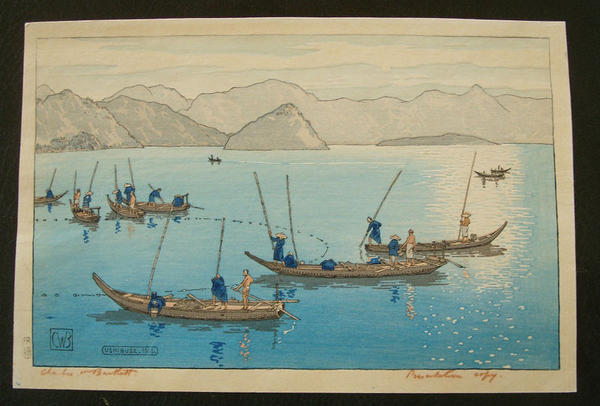
Ushibuse
- Date:
- 1916
- Medium:
- Woodblock print
- Format:
- Oban
- Source:
- Japanese Art Open Database
Description
Ushibuse, created in 1916, depicts a location in rural Japan whose name suggests a place associated with cattle and the agricultural landscape of the Japanese countryside. Unlike the famous scenic spots and urban centers that attracted most travel-oriented artists, Ushibuse represents the quieter Japan of farming villages, rice paddies, and the slow rhythms of agrarian life that persisted well into the twentieth century.
Bartlett's oban woodblock print records this rural scene with the plein-air sensitivity he developed through his European watercolor training. The Japanese countryside offered subjects of understated beauty: thatched farmhouses against a backdrop of low hills, water-filled rice fields reflecting the sky, and the particular quality of diffused light that characterizes the humid lowland landscapes of central Honshu. Bartlett's willingness to depict such everyday scenes alongside his more dramatic subjects, the Taj Mahal, the Khyber Pass, and the Golden Temple, speaks to his genuine interest in the full range of Asian visual experience.
More Prints by Charles W. Bartlett

More Landscapes Prints

Lake Kugushi in Wakasa Province (Wakasa Kugushiko), from the series Souvenirs of Travel I (Tabi miyage dai isshu)"
Wakasa Kugushiko
1920
Color woodblock print; oban
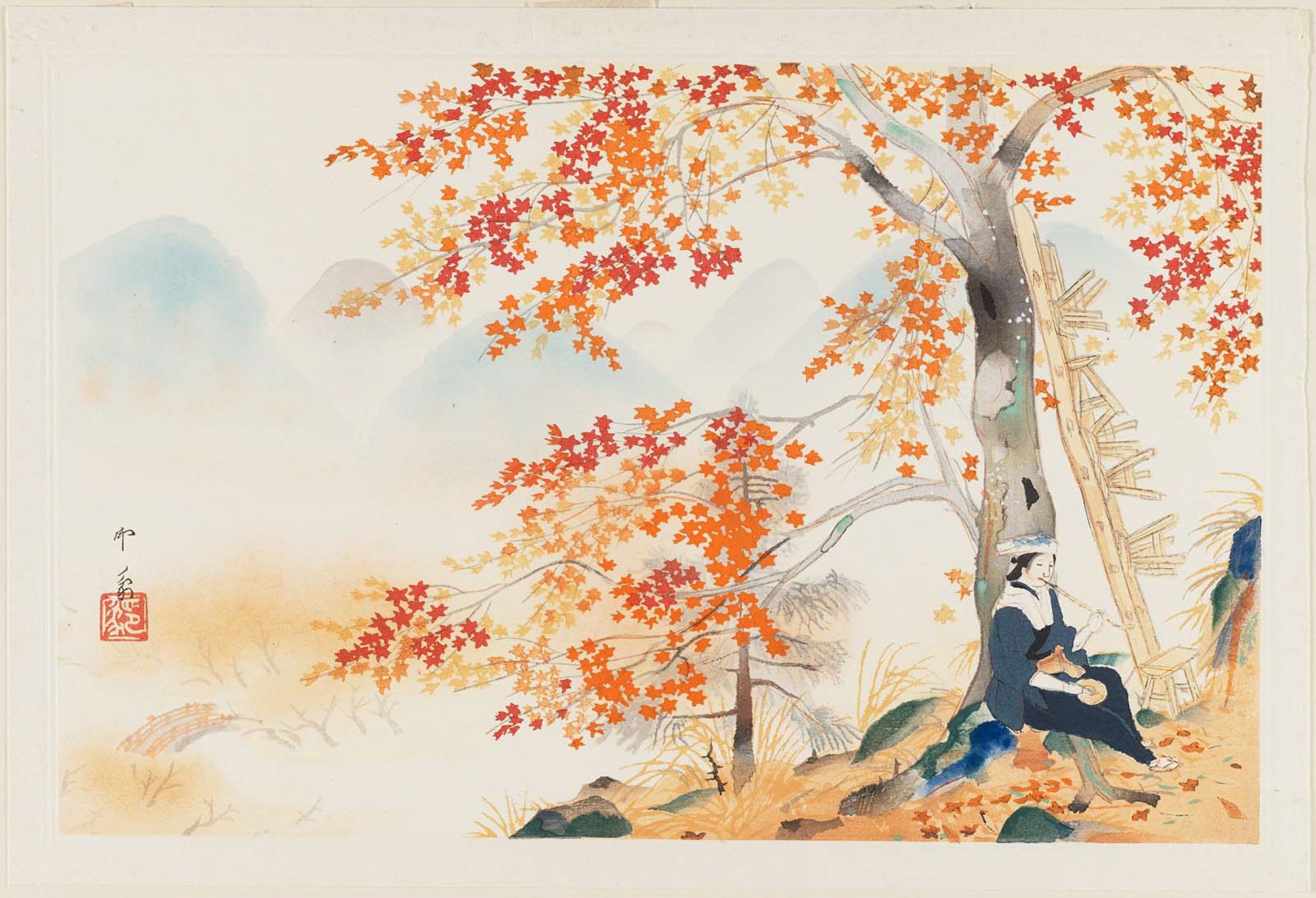
Autumn Maple Leaves at Takao, from the album Eight Views of Kyoto (Kyôto hakkei)
Woodblock print

The Beach at Kaiganji in Sanuki Province (Sanuki Kaiganji no hama), from the series "Collection of Views of Japan II, Kansai Edition (Nihon fukei shu II Kansai hen)"
1934
Color woodblock print; oban

Tea Kettle, section of a sheet from the series "Mirror of Stone Rubbings of Views of the Provinces" (Kohon meihitsu ishizuri kagami)
n.d.
Woodblock print; ishizuri-e, section of harimaze sheet
Featured in Collections
Curated cross-cuts that include this print.
Frequently Asked Questions
Ushibuse was created by Charles W. Bartlett in 1916.
Ushibuse depicts landscapes and village scenes.