
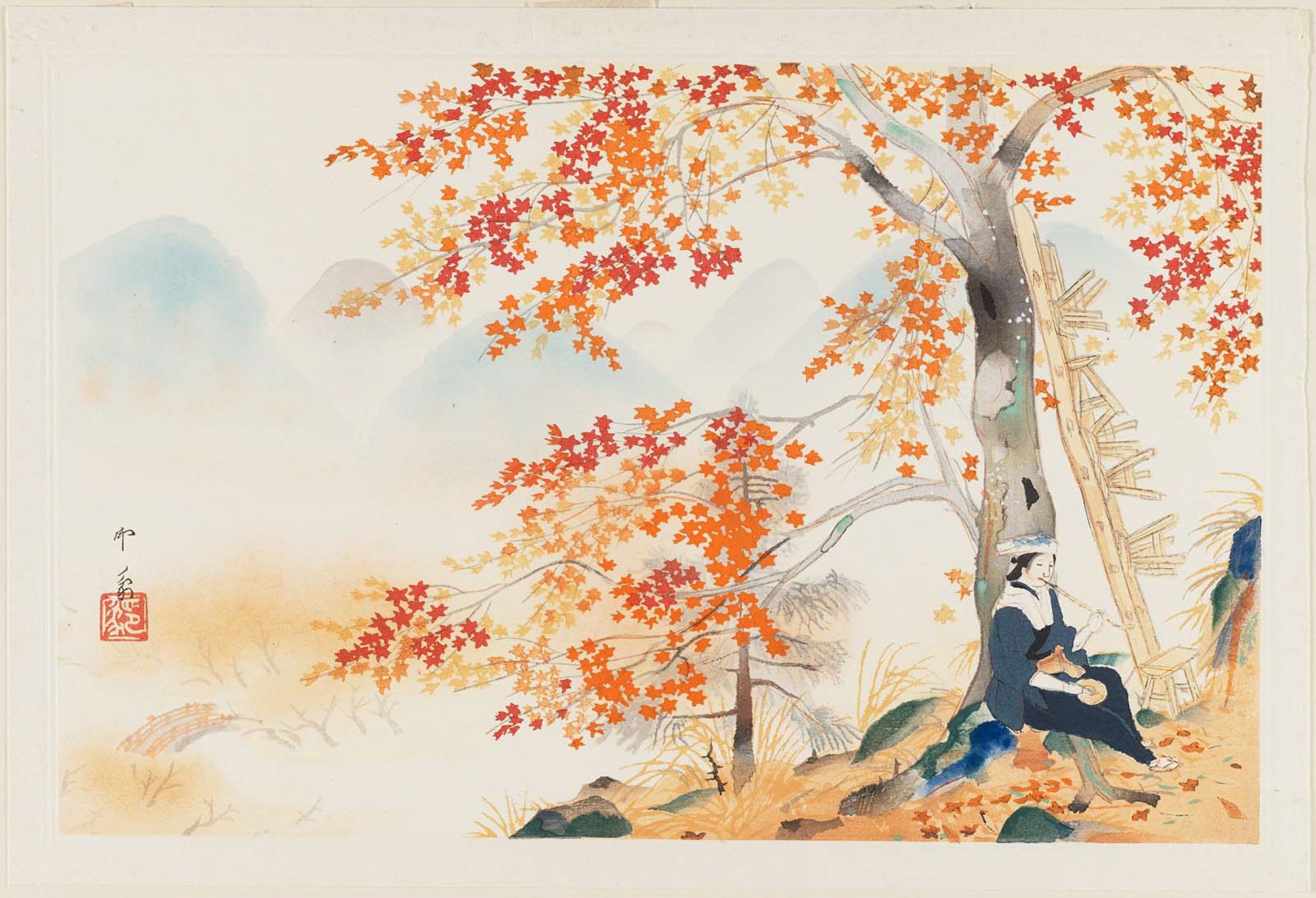
Arashiyama, from the series "Eight Scenes of Cherry Blossoms"
- Series:
- Eight Scenes of Cherry Blossoms (print 3 of 8)
- Date:
- 1935
- Medium:
- Color woodblock print
- Format:
- Oban
- Dimensions:
- 27.3 × 40.5 cm
- Publisher:
- Yoshida Studio
- Source:
- Art Institute of Chicago
Description
Arashiyama — the storied western district of Kyoto where the Oi River curves beneath bamboo groves and cherry-lined hillsides — appears in this 1935 print as part of Yoshida's Eight Scenes of Cherry Blossoms series. The site has been celebrated for its cherry blossoms since the Heian period, and Yoshida depicts the peak-bloom moment when the hillside above the river is engulfed in white and pale pink. The composition likely incorporates the Togetsukyo Bridge, which frames views of cherry-covered Arashiyama from the riverbank — a viewpoint that has defined the scene in Japanese art for centuries. Yoshida's treatment gives the classical subject fresh luminosity through his control of pigment layering.
Current Listings
$3,200
More Prints by Hiroshi Yoshida
More Landscapes Prints

Lake Kugushi in Wakasa Province (Wakasa Kugushiko), from the series Souvenirs of Travel I (Tabi miyage dai isshu)"
Wakasa Kugushiko
1920
Color woodblock print; oban
Autumn Maple Leaves at Takao, from the album Eight Views of Kyoto (Kyôto hakkei)
Woodblock print

The Beach at Kaiganji in Sanuki Province (Sanuki Kaiganji no hama), from the series "Collection of Views of Japan II, Kansai Edition (Nihon fukei shu II Kansai hen)"
1934
Color woodblock print; oban

Tea Kettle, section of a sheet from the series "Mirror of Stone Rubbings of Views of the Provinces" (Kohon meihitsu ishizuri kagami)
n.d.
Woodblock print; ishizuri-e, section of harimaze sheet
Featured in Collections
Curated cross-cuts that include this print.
Frequently Asked Questions
Arashiyama, from the series "Eight Scenes of Cherry Blossoms" was created by Hiroshi Yoshida (吉田博) in 1935.
Yes — Arashiyama, from the series "Eight Scenes of Cherry Blossoms" is part of the Eight Scenes of Cherry Blossoms series (print 3 of 8) by Hiroshi Yoshida.
Arashiyama, from the series "Eight Scenes of Cherry Blossoms" uses Bokashi, Nishiki-e, and Moku-hanga, on color woodblock print.
Arashiyama, from the series "Eight Scenes of Cherry Blossoms" was published by Yoshida Studio (1935).
Arashiyama, from the series "Eight Scenes of Cherry Blossoms" depicts landscapes, cherry blossoms, and rivers & lakes, set at Kyoto, Arashiyama.
Arashiyama, from the series "Eight Scenes of Cherry Blossoms" measures 27.3 × 40.5 cm (Oban format).