
Clearing after a Snowfall at the Sekiyado (Sekiyado no yukibare)
by Kawase Hasui
- Date:
- 1946
- Medium:
- Color woodblock print
- Format:
- Oban
- Publisher:
- Watanabe Shozaburo
- Edition:
- Published by Watanabe Shozaburo
- Source:
- Art Institute of Chicago
Description
Snow-covered thatched-roof farmhouses stand along a curving path in a rural village, with bare and evergreen trees dusted with snow and small conical snow-covered shrubs in front of a bamboo fence. A single figure in dark clothing walks along the cleared dirt path, which cuts through snow-blanketed fields still showing rows of green winter crops. The sky transitions from deep blue at the top through pink and pale lavender clouds near the horizon, suggesting early morning or evening light; the print is captioned "Sunshine after snow at Sekiyado" and signed Kawase Hasui.
More Prints by Kawase Hasui

More Snow Scenes Prints
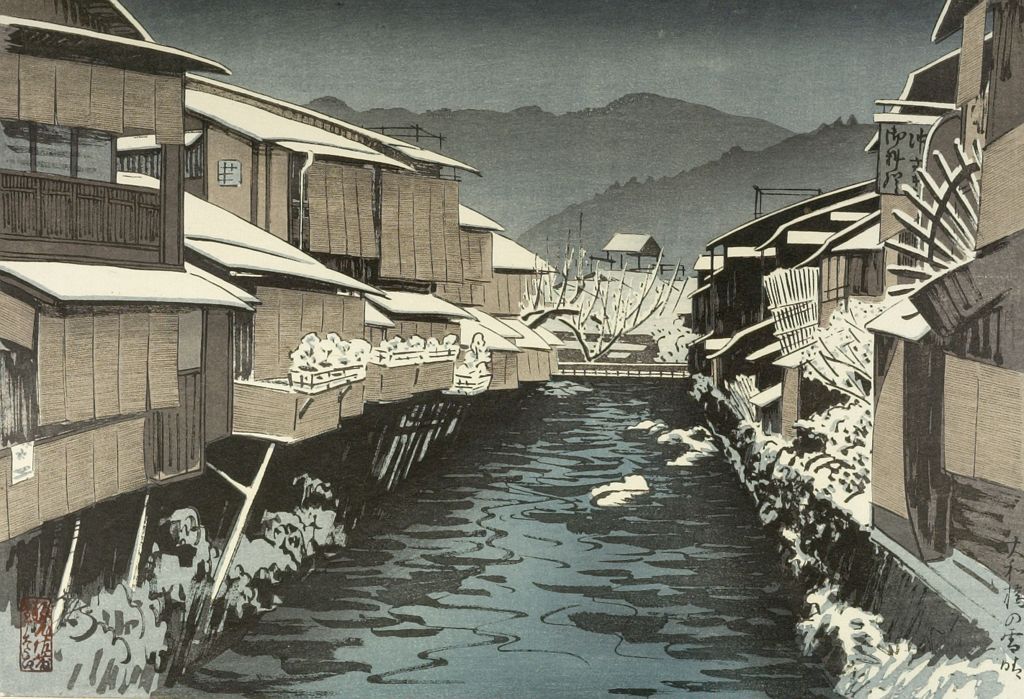
Fair Weather After Snow at Yamato Bridge, Kyoto (Yamato bashi no yukibare), Taishô period, dated 1924
Woodblock print

The Compound of the Tenman Shrine at Kameido in the Snow (Kameido Tenmangu keidai no yuki), from the series "Famous Places in the Eastern Capital (Toto meisho)"
c. 1832/38
Color woodblock print; oban

Miyajima in Snow (Yuki no Miyajima)
Yuki no Miyajima
1929
Color woodblock print; oban
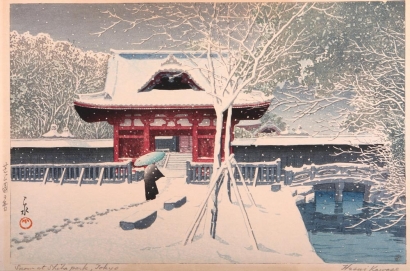
Evening Snow at Shiha Park, Tokyo
1932
Woodblock print
Featured in Collections
Curated cross-cuts that include this print.
Frequently Asked Questions
Clearing after a Snowfall at the Sekiyado (Sekiyado no yukibare) was created by Kawase Hasui (川瀬巴水) in 1946.
Clearing after a Snowfall at the Sekiyado (Sekiyado no yukibare) uses Bokashi, on color woodblock print.
Clearing after a Snowfall at the Sekiyado (Sekiyado no yukibare) was published by Watanabe Shozaburo (1946).
Clearing after a Snowfall at the Sekiyado (Sekiyado no yukibare) depicts snow scenes.