
Clearing after a Snowfall, Yoshida (Yoshida no yukibare)
by Kawase Hasui
- Date:
- 1944
- Medium:
- Color woodblock print
- Format:
- Oban
- Publisher:
- Watanabe Shozaburo
- Edition:
- Published by Watanabe Shozaburo
- Source:
- Art Institute of Chicago
Description
Clearing after a Snowfall at Yoshida, published in 1944, depicts the town of Yoshida — either Yoshida-cho in Shizuoka at the foot of the Fuji region, or another Yoshida settlement — under the clear sky following a snowstorm. The yukibare subject applied to a small town rather than a famous landmark gives the 1944 wartime composition a quiet, domestic quality: the ordinary vernacular architecture of a provincial Japanese town transformed by fresh snow into a composition of pure white and dark timber. The wartime date suggests this was produced during a period of restricted travel when local subjects had to substitute for more distant landscapes.
More Prints by Kawase Hasui

More Snow Scenes Prints
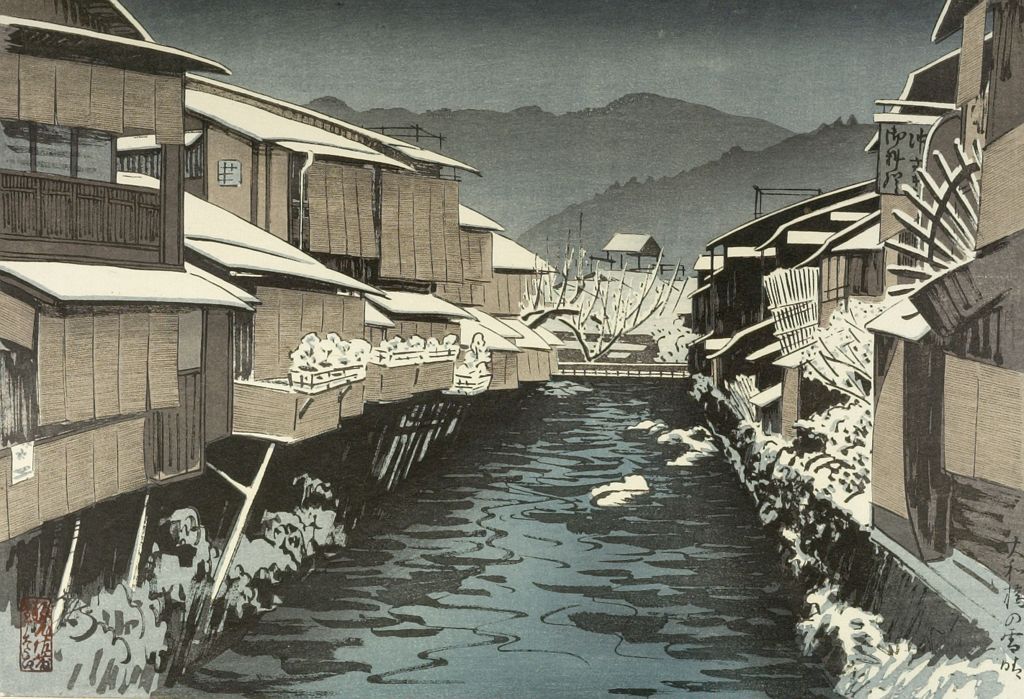
Fair Weather After Snow at Yamato Bridge, Kyoto (Yamato bashi no yukibare), Taishô period, dated 1924
Woodblock print

The Compound of the Tenman Shrine at Kameido in the Snow (Kameido Tenmangu keidai no yuki), from the series "Famous Places in the Eastern Capital (Toto meisho)"
c. 1832/38
Color woodblock print; oban

Miyajima in Snow (Yuki no Miyajima)
Yuki no Miyajima
1929
Color woodblock print; oban
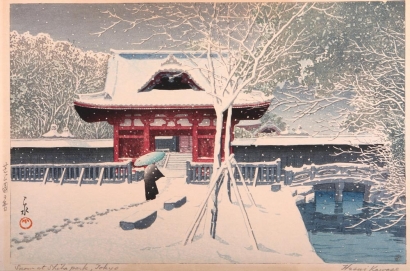
Evening Snow at Shiha Park, Tokyo
1932
Woodblock print
Featured in Collections
Curated cross-cuts that include this print.
Frequently Asked Questions
Clearing after a Snowfall, Yoshida (Yoshida no yukibare) was created by Kawase Hasui (川瀬巴水) in 1944.
Clearing after a Snowfall, Yoshida (Yoshida no yukibare) uses Bokashi, on color woodblock print.
Clearing after a Snowfall, Yoshida (Yoshida no yukibare) was published by Watanabe Shozaburo (1944).
Clearing after a Snowfall, Yoshida (Yoshida no yukibare) depicts snow scenes.