
Dusk at Byodo Temple (Byodoin no yu)
by Kawase Hasui
- Date:
- 1950
- Medium:
- Color woodblock print
- Format:
- Oban
- Publisher:
- Watanabe Shozaburo
- Edition:
- Published by Watanabe Shozaburo
- Source:
- Art Institute of Chicago
Description
Dusk at Byodo Temple (Byodoin no yu), published in 1950, depicts the Phoenix Hall of Byodoin at Uji in the transitional light of dusk — the yu subject that softened the temple's famous gold-and-lacquer architecture into warm silhouette against the evening sky, its reflection elongating in the mirror pond as the day's last light faded. The dusk treatment of Byodoin offers a very different atmosphere from the daytime or reflected-daylight treatments: the buildings' elaborate decorative surfaces giving way to a simpler silhouette drama as the light fails, the pond's reflection becoming the composition's luminous center. The 1950 date places this among Hasui's late-career revisits to Heian landmarks.
More Prints by Kawase Hasui

More Temples & Shrines Prints
Fushimi Inari Temple
伏見稲荷
Woodblock print

The Compound of the Tenman Shrine at Kameido in the Snow (Kameido Tenmangu keidai no yuki), from the series "Famous Places in the Eastern Capital (Toto meisho)"
c. 1832/38
Color woodblock print; oban
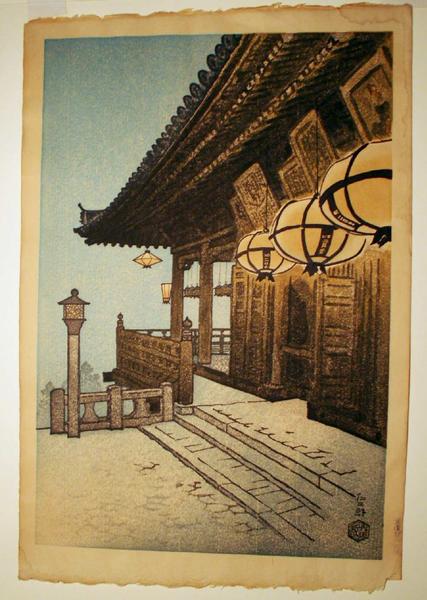
Temple with lanterns
Woodblock print

A Section of the Byodo Temple at Uji (Uji Byodoin no ichibu), from the series "Souvenirs of Travel, Second Series (Tabi miyage dai nishu)"
Uji Byodoin no ichibu
1921
Color woodblock print; oban
Featured in Collections
Curated cross-cuts that include this print.
Frequently Asked Questions
Dusk at Byodo Temple (Byodoin no yu) was created by Kawase Hasui (川瀬巴水) in 1950.
Dusk at Byodo Temple (Byodoin no yu) uses Bokashi, on color woodblock print.
Dusk at Byodo Temple (Byodoin no yu) was published by Watanabe Shozaburo (1950).
Dusk at Byodo Temple (Byodoin no yu) depicts temples & shrines and night scenes.