
Eastern Hamlet, Horyu Temple (Horyuji higashi sato)
by Kawase Hasui
- Date:
- 1956
- Medium:
- Color woodblock print
- Format:
- Oban
- Publisher:
- Watanabe Shozaburo
- Edition:
- Published by Watanabe Shozaburo
- Source:
- Art Institute of Chicago
Description
Eastern Hamlet at Horyu Temple, published in 1956, depicts the eastern precinct (Higashi Sato) of Horyuji — the seventh-century Buddhist temple complex near Nara that houses the world's oldest surviving wooden structures — and specifically the Chuguji convent and Yumedono (Hall of Dreams) octagonal hall that form its eastern extension. The 1956 date makes this among Hasui's final significant prints before his 1957 death, and his choice of Horyuji's eastern hamlet — quieter and less monumental than the western main precinct — reflects a late-career preference for intimate and unexpected compositions of well-known sites. The village setting (sato) gives the famous temple complex a domestic, human-scaled presence.
More Prints by Kawase Hasui

More Temples & Shrines Prints
Fushimi Inari Temple
伏見稲荷
Woodblock print

The Compound of the Tenman Shrine at Kameido in the Snow (Kameido Tenmangu keidai no yuki), from the series "Famous Places in the Eastern Capital (Toto meisho)"
c. 1832/38
Color woodblock print; oban
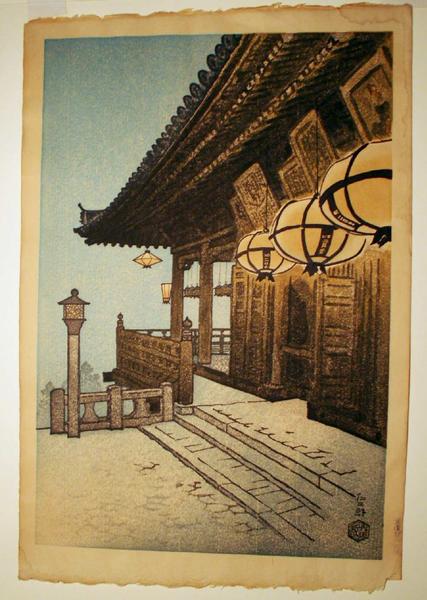
Temple with lanterns
Woodblock print

A Section of the Byodo Temple at Uji (Uji Byodoin no ichibu), from the series "Souvenirs of Travel, Second Series (Tabi miyage dai nishu)"
Uji Byodoin no ichibu
1921
Color woodblock print; oban
Featured in Collections
Curated cross-cuts that include this print.
Frequently Asked Questions
Eastern Hamlet, Horyu Temple (Horyuji higashi sato) was created by Kawase Hasui (川瀬巴水) in 1956.
Eastern Hamlet, Horyu Temple (Horyuji higashi sato) uses Bokashi, on color woodblock print.
Eastern Hamlet, Horyu Temple (Horyuji higashi sato) was published by Watanabe Shozaburo (1956).
Eastern Hamlet, Horyu Temple (Horyuji higashi sato) depicts temples & shrines and village scenes.