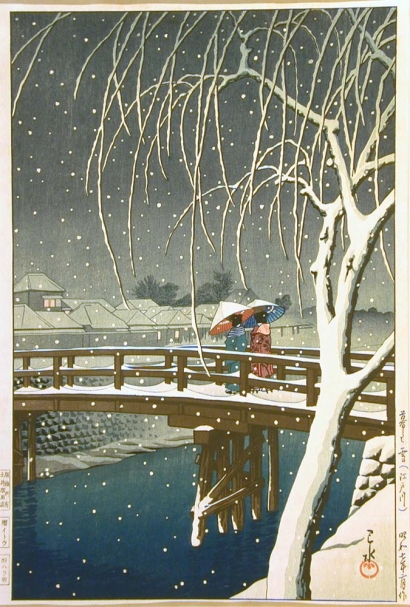
Late Snow Along Edo River
by Kawase Hasui
- Date:
- 1932
- Medium:
- Woodblock print
- Format:
- Oban
- Publisher:
- Watanabe Shozaburo
- Edition:
- Published by Watanabe Shozaburo
- Source:
- Art Gallery of Greater Victoria
Description
Late Snow Along the Edo River, published in 1932, depicts the Edogawa — the lower section of the Tone River's western outflow, forming the boundary between Tokyo and Chiba — under late-season snowfall that whitens the flat river banks and marshes of this wide, slow-moving watercourse on the eastern edge of the Kanto plain. The late snow (the March or April snowfall that comes after the apparent arrival of spring) has a particular atmospheric character: the white accumulation against the green of emerging spring vegetation, the low gray sky contrasting with the first signs of seasonal change. The bokashi sky captures the muted palette of this transitional weather.
More Prints by Kawase Hasui

More Snow Scenes Prints
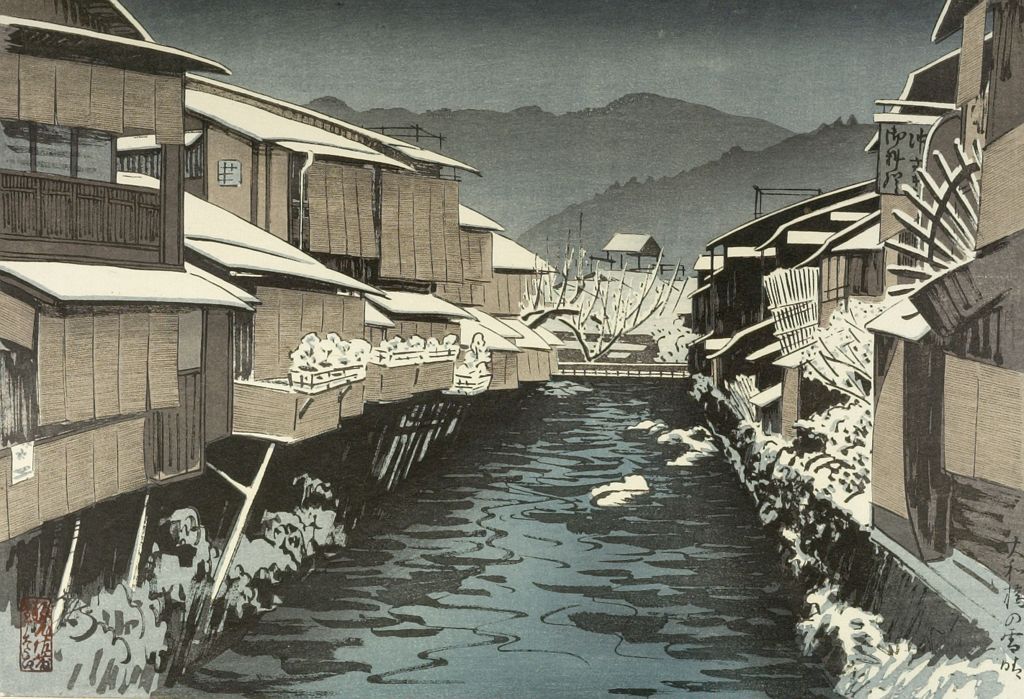
Fair Weather After Snow at Yamato Bridge, Kyoto (Yamato bashi no yukibare), Taishô period, dated 1924
Woodblock print

The Compound of the Tenman Shrine at Kameido in the Snow (Kameido Tenmangu keidai no yuki), from the series "Famous Places in the Eastern Capital (Toto meisho)"
c. 1832/38
Color woodblock print; oban

Miyajima in Snow (Yuki no Miyajima)
Yuki no Miyajima
1929
Color woodblock print; oban
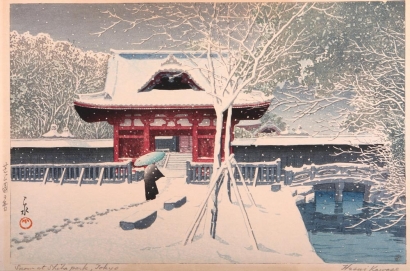
Evening Snow at Shiha Park, Tokyo
1932
Woodblock print
Featured in Collections
Curated cross-cuts that include this print.
Frequently Asked Questions
Late Snow Along Edo River was created by Kawase Hasui (川瀬巴水) in 1932.
Late Snow Along Edo River uses Bokashi, on woodblock print.
Late Snow Along Edo River was published by Watanabe Shozaburo (1932).
Late Snow Along Edo River depicts snow scenes and rivers & lakes, set at Tokyo.