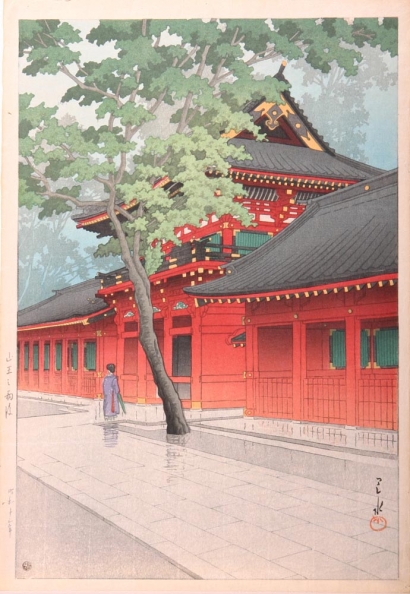
Sano Shrine After the Rain
by Kawase Hasui
- Date:
- 1938
- Medium:
- Woodblock print
- Format:
- Oban
- Publisher:
- Watanabe Shozaburo
- Edition:
- Published by Watanabe Shozaburo
- Source:
- Art Gallery of Greater Victoria
Description
"Sano Shrine After the Rain" (1938), a woodblock print by Kawase Hasui, depicts a vermillion-red shrine building with a dark tiled gable roof and gold-accented eaves, set behind a stone-paved courtyard slick with rainwater. A tall tree with a slender trunk and green foliage rises before the building's corner, partially screening a low wooden fence, while a single figure in a blue kimono walks alone along the pavement. The palette is dominated by the shrine's deep red against muted greens and pale grey stone, with a soft, overcast blue-grey sky visible above the rooftops.
More Prints by Kawase Hasui

More Temples & Shrines Prints
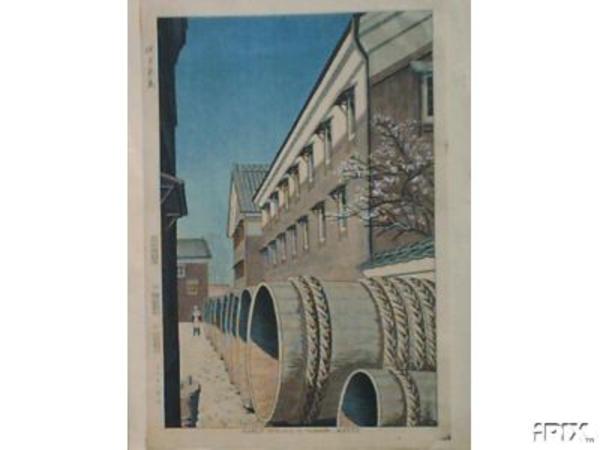
Fushimi Inari Temple
伏見稲荷
Woodblock print

The Compound of the Tenman Shrine at Kameido in the Snow (Kameido Tenmangu keidai no yuki), from the series "Famous Places in the Eastern Capital (Toto meisho)"
c. 1832/38
Color woodblock print; oban
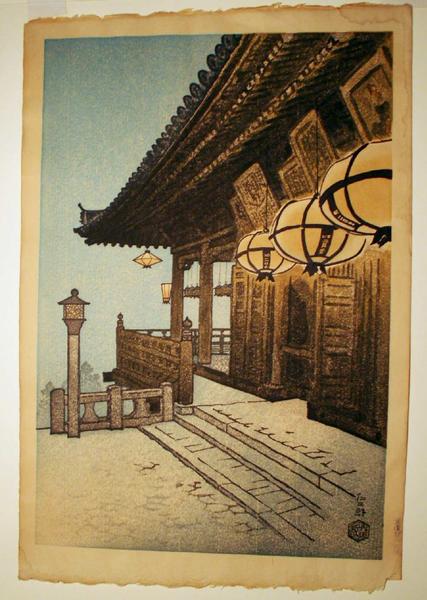
Temple with lanterns
Woodblock print

A Section of the Byodo Temple at Uji (Uji Byodoin no ichibu), from the series "Souvenirs of Travel, Second Series (Tabi miyage dai nishu)"
Uji Byodoin no ichibu
1921
Color woodblock print; oban
Featured in Collections
Curated cross-cuts that include this print.
Frequently Asked Questions
Sano Shrine After the Rain was created by Kawase Hasui (川瀬巴水) in 1938.
Sano Shrine After the Rain uses Bokashi, on woodblock print.
Sano Shrine After the Rain was published by Watanabe Shozaburo (1938).
Sano Shrine After the Rain depicts temples & shrines and rain.