
Snow at a Guest House on Pond's Edge (Chihan kyakushitshu no yuki)
by Kawase Hasui
- Date:
- 1920
- Medium:
- Color woodblock print
- Format:
- Oban
- Publisher:
- Watanabe Shozaburo
- Edition:
- Published by Watanabe Shozaburo
- Source:
- Art Institute of Chicago
Description
Snow falls over a dark blue pond edged by a stepping-stone path, its flat rocks blanketed in white and leading toward a snow-laden guest house at right with lantern-lit windows glowing red-orange within its dark wooden frame. Heavy snow weighs down the trees, bushes, and a low fence in the background, rendered in soft grey-white against the deep indigo water and a shadowed blue-grey sky flecked with falling snow. Kawase Hasui, "Snow at a Guest House on Pond's Edge (Chihan kyakushitshu no yuki)," 1920, color woodblock print.
More Prints by Kawase Hasui

More Snow Scenes Prints
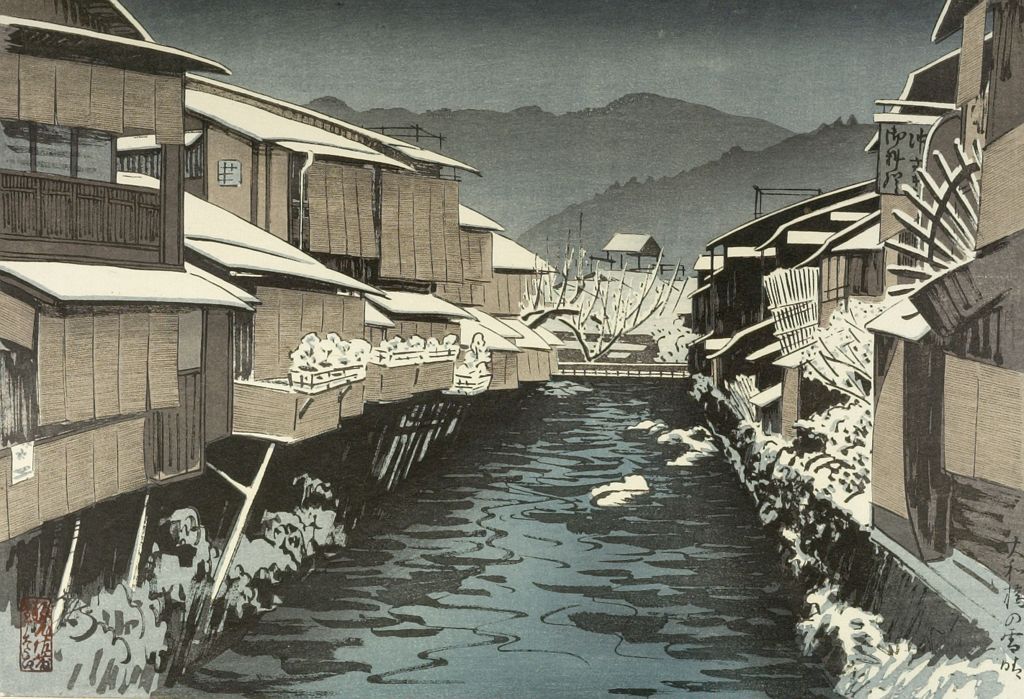
Fair Weather After Snow at Yamato Bridge, Kyoto (Yamato bashi no yukibare), Taishô period, dated 1924
Woodblock print

The Compound of the Tenman Shrine at Kameido in the Snow (Kameido Tenmangu keidai no yuki), from the series "Famous Places in the Eastern Capital (Toto meisho)"
c. 1832/38
Color woodblock print; oban

Miyajima in Snow (Yuki no Miyajima)
Yuki no Miyajima
1929
Color woodblock print; oban
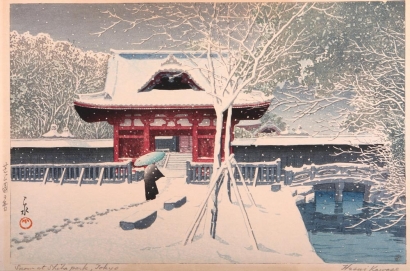
Evening Snow at Shiha Park, Tokyo
1932
Woodblock print
Featured in Collections
Curated cross-cuts that include this print.
Frequently Asked Questions
Snow at a Guest House on Pond's Edge (Chihan kyakushitshu no yuki) was created by Kawase Hasui (川瀬巴水) in 1920.
Snow at a Guest House on Pond's Edge (Chihan kyakushitshu no yuki) uses Bokashi, on color woodblock print.
Snow at a Guest House on Pond's Edge (Chihan kyakushitshu no yuki) was published by Watanabe Shozaburo (1920).
Snow at a Guest House on Pond's Edge (Chihan kyakushitshu no yuki) depicts snow scenes and rivers & lakes.