
Snow at Kiyomizu Hall, Ueno (Ueno Kiyomizudo no yuki)
Ueno Kiyomizudo no yuki
by Kawase Hasui
- Date:
- 1929
- Medium:
- Color woodblock print; oban
- Format:
- Oban
- Dimensions:
- 27.6 × 40.7 cm
- Publisher:
- Watanabe Shozaburo
- Edition:
- Published by Watanabe Shozaburo
- Source:
- Art Institute of Chicago
Description
Snow at Kiyomizu Hall, Ueno presents a beloved Tokyo landmark transformed by winter snowfall. Created in 1929 and published by Watanabe Shozaburo, this print depicts Kiyomizu Kannon-do, a small temple hall in Tokyo's Ueno Park modeled after the famous Kiyomizu-dera in Kyoto. The hall sits on an elevated position overlooking Shinobazu Pond, its elegant wooden structure and curved roofline dusted with fresh snow. The surrounding trees, stripped of leaves in winter, create a delicate network of bare branches against the snow-laden sky, while the accumulated snow softens every surface into gentle, rounded forms.
Kiyomizu Kannon-do was built in 1631 by the monk Tenkai as part of Kan'ei-ji temple complex, and it is one of the few structures in Ueno that survived the devastating Battle of Ueno in 1868 during the Boshin War. By Hasui's time, the surrounding area had been transformed into Ueno Park, Tokyo's first public park, making the temple hall an island of historical architecture amid a modern recreational landscape. Hasui's depiction focuses on the temple itself and its immediate natural surroundings, isolating it from the urban context to emphasize its architectural beauty and spiritual atmosphere.
The year 1929 was extraordinarily productive for Hasui's snow scenes, also yielding the masterpieces Snow at Zojoji Temple and Miyajima in Snow. This concentration of exceptional winter compositions suggests a period of particular creative inspiration and technical refinement. The printing of Snow at Kiyomizu Hall demonstrates the artist's and craftsmen's mastery of the snow genre, with subtle variations in white tones distinguishing between snow on the roof, snow on tree branches, snow on the ground, and snow falling through the air. The composition's intimate scale and quiet beauty make it a characteristic example of Hasui's ability to find poetry in Tokyo's historical corners.
More Prints by Kawase Hasui
More Urban Scenes Prints
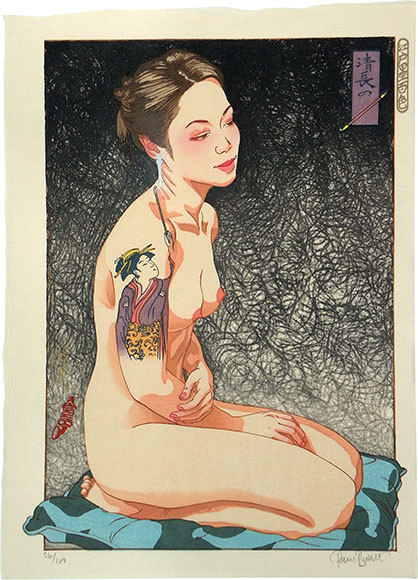
A Hundred Shades of Ink of Edo: Kiyonaga's Pipe (Edo zumi hyaku shoku: Kiyonaga no kiseru)
Woodblock print

View of Kabuki Theater from Matsuya (Ginza Matsuya yori Kabukiza), no. 3 from the series "Pictures of Ginza, First Series (Gashu Ginza dai isshu)"
1928
Color lithograph

Distant View of Mitsukoshi Movie Theater in Shinjuku from the Sixth Floor of Hoteiya (Hoteiya rokkai kara Shinjuku Mitsukoshi Musashi no kan enbo zu), no. 1 from the series "Scenery of Shinjuku (Gashu Shinjuku fukei)"
1930
Color lithograph
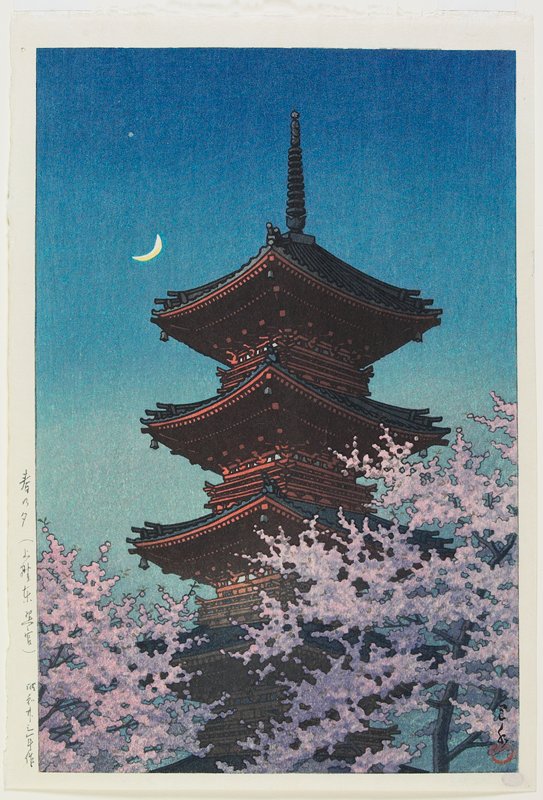
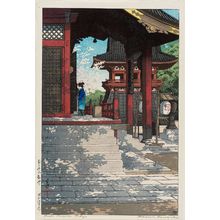
Spring Dusk at the Tōshō Shrine in Ueno
1948
Woodblock print, ink and color on paper
Featured in Collections
Curated cross-cuts that include this print.
Frequently Asked Questions
Snow at Kiyomizu Hall, Ueno (Ueno Kiyomizudo no yuki) (Ueno Kiyomizudo no yuki) was created by Kawase Hasui (川瀬巴水) in 1929.
Snow at Kiyomizu Hall, Ueno (Ueno Kiyomizudo no yuki) uses Bokashi, Karazuri, and Nishiki-e, on color woodblock print; oban.
Snow at Kiyomizu Hall, Ueno (Ueno Kiyomizudo no yuki) was published by Watanabe Shozaburo (1929).
Snow at Kiyomizu Hall, Ueno (Ueno Kiyomizudo no yuki) depicts urban scenes, snow scenes, and temples & shrines, set at Tokyo, Kyoto, Ueno, Kiyomizu Temple.
Snow at Kiyomizu Hall, Ueno (Ueno Kiyomizudo no yuki) measures 27.6 × 40.7 cm (Oban format).