
Snow at Kiyosumi Garden (Kiyosumien no yuki)
by Kawase Hasui
- Date:
- February 1938
- Medium:
- Color woodblock print
- Format:
- Oban
- Publisher:
- Watanabe Shozaburo
- Edition:
- Published by Watanabe Shozaburo
- Source:
- Art Institute of Chicago
Description
Kiyosumi Garden in Fukagawa under February snow shows the Meiji-era garden pond with snow accumulated on the stepping stones, the pine trees bearing heavy loads on each branch, and the stone lanterns capped in white. This 1938 print pairs with the 1938 moonlight view of the same garden, offering the same space under two of Hasui's most cherished atmospheric conditions. The garden's carefully designed landscape — every rock, tree, and lantern positioned deliberately — gave the snow composition an architectural clarity.
More Prints by Kawase Hasui

More Snow Scenes Prints
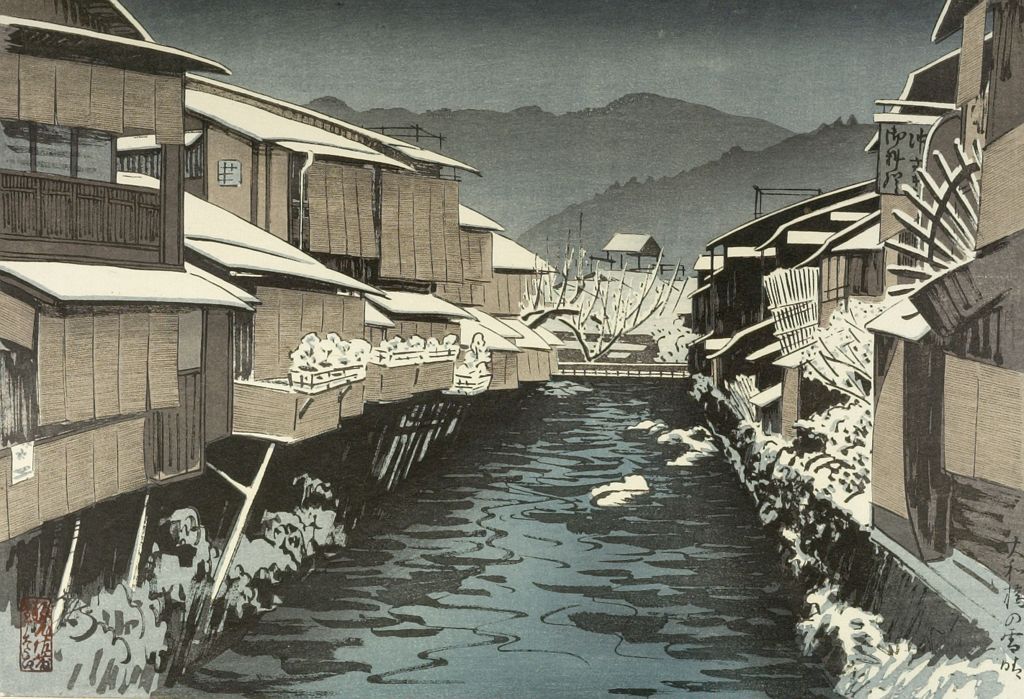
Fair Weather After Snow at Yamato Bridge, Kyoto (Yamato bashi no yukibare), Taishô period, dated 1924
Woodblock print

The Compound of the Tenman Shrine at Kameido in the Snow (Kameido Tenmangu keidai no yuki), from the series "Famous Places in the Eastern Capital (Toto meisho)"
c. 1832/38
Color woodblock print; oban

Miyajima in Snow (Yuki no Miyajima)
Yuki no Miyajima
1929
Color woodblock print; oban
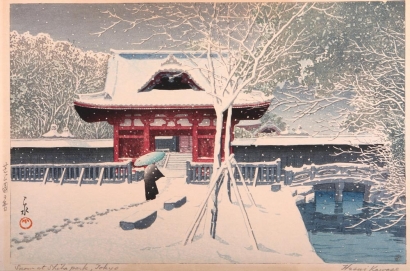
Evening Snow at Shiha Park, Tokyo
1932
Woodblock print
Featured in Collections
Curated cross-cuts that include this print.
Frequently Asked Questions
Snow at Kiyosumi Garden (Kiyosumien no yuki) was created by Kawase Hasui (川瀬巴水) in February 1938.
Snow at Kiyosumi Garden (Kiyosumien no yuki) uses Bokashi, on color woodblock print.
Snow at Kiyosumi Garden (Kiyosumien no yuki) was published by Watanabe Shozaburo (February 1938).
Snow at Kiyosumi Garden (Kiyosumien no yuki) depicts snow scenes and gardens.