
Snow at Mukojima (Yuki no Mukojima)
Yuki no Mukojima
by Kawase Hasui
- Date:
- December 1931
- Medium:
- Color woodblock print
- Format:
- Oban
- Dimensions:
- 24 × 36.3 cm
- Publisher:
- Watanabe Shozaburo
- Edition:
- Published by Watanabe Shozaburo
- Source:
- Art Institute of Chicago
Description
Snow at Mukojima, published in December 1931, depicts the low-lying district of Mukojima on the eastern bank of the Sumida River in Tokyo — historically associated with cherry blossoms and the Sumida's pleasure boating culture — under a snowfall that transforms its waterway landscape into a white and gray composition. Mukojima's embankment and the willow trees along the Sumida's bank, blanketed in snow and reflected in the still river, create the kind of intimate urban winter scene that made Hasui's Tokyo snow prints so beloved. The December publication aligns with the print's seasonal subject.
More Prints by Kawase Hasui

More Snow Scenes Prints
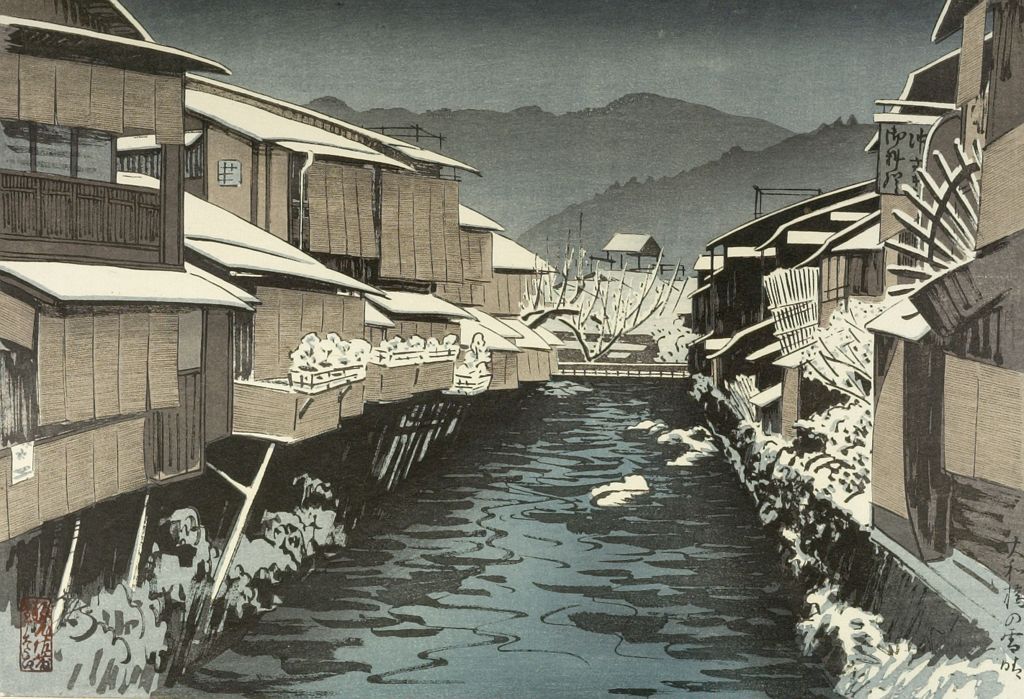
Fair Weather After Snow at Yamato Bridge, Kyoto (Yamato bashi no yukibare), Taishô period, dated 1924
Woodblock print

The Compound of the Tenman Shrine at Kameido in the Snow (Kameido Tenmangu keidai no yuki), from the series "Famous Places in the Eastern Capital (Toto meisho)"
c. 1832/38
Color woodblock print; oban

Miyajima in Snow (Yuki no Miyajima)
Yuki no Miyajima
1929
Color woodblock print; oban
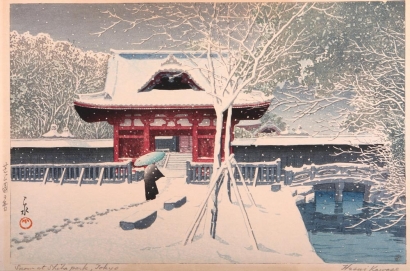
Evening Snow at Shiha Park, Tokyo
1932
Woodblock print
Featured in Collections
Curated cross-cuts that include this print.
Frequently Asked Questions
Snow at Mukojima (Yuki no Mukojima) (Yuki no Mukojima) was created by Kawase Hasui (川瀬巴水) in December 1931.
Snow at Mukojima (Yuki no Mukojima) uses Bokashi, Karazuri, and Nishiki-e, on color woodblock print.
Snow at Mukojima (Yuki no Mukojima) was published by Watanabe Shozaburo (December 1931).
Snow at Mukojima (Yuki no Mukojima) depicts snow scenes.
Snow at Mukojima (Yuki no Mukojima) measures 24 × 36.3 cm (Oban format).