
Sobu Garden, Meiji Shrine (Meiji jingu Sobuen)
by Kawase Hasui
- Date:
- 1951
- Medium:
- Color woodblock print
- Format:
- Oban
- Publisher:
- Watanabe Shozaburo
- Edition:
- Published by Watanabe Shozaburo
- Source:
- Art Institute of Chicago
Description
The Sobu Garden at Meiji Shrine in Tokyo is the iris garden in the inner grounds of the shrine, its channels of flowing water and thousands of irises in bloom each June making it one of the finest of Tokyo's flower gardens. This 1951 print likely shows the garden in iris season — the purple and white flowers reflected in the water channels — with the shrine's cedar forest providing the deep green enclosure that defines the garden's atmosphere. The shrine's combination of sacred architecture and ornamental garden gave Hasui a richly layered subject.
More Prints by Kawase Hasui

More Temples & Shrines Prints

Fushimi Inari Temple
伏見稲荷
Woodblock print

The Compound of the Tenman Shrine at Kameido in the Snow (Kameido Tenmangu keidai no yuki), from the series "Famous Places in the Eastern Capital (Toto meisho)"
c. 1832/38
Color woodblock print; oban
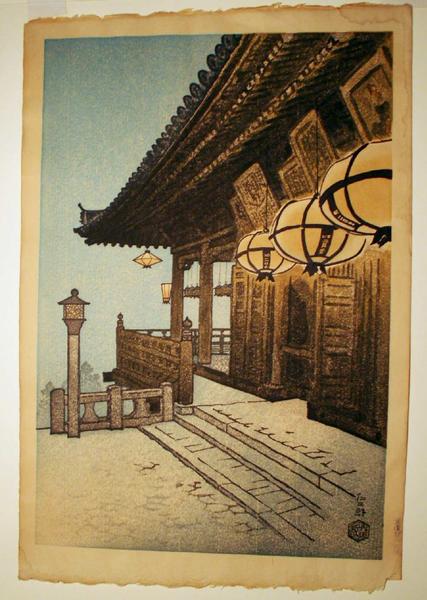
Temple with lanterns
Woodblock print

A Section of the Byodo Temple at Uji (Uji Byodoin no ichibu), from the series "Souvenirs of Travel, Second Series (Tabi miyage dai nishu)"
Uji Byodoin no ichibu
1921
Color woodblock print; oban
Featured in Collections
Curated cross-cuts that include this print.
Frequently Asked Questions
Sobu Garden, Meiji Shrine (Meiji jingu Sobuen) was created by Kawase Hasui (川瀬巴水) in 1951.
Sobu Garden, Meiji Shrine (Meiji jingu Sobuen) uses Bokashi, on color woodblock print.
Sobu Garden, Meiji Shrine (Meiji jingu Sobuen) was published by Watanabe Shozaburo (1951).
Sobu Garden, Meiji Shrine (Meiji jingu Sobuen) depicts temples & shrines and gardens.