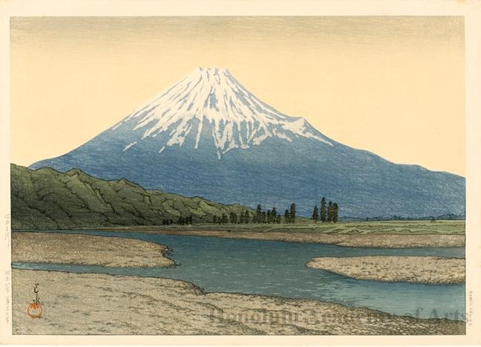
The Fuji River
by Kawase Hasui
- Medium:
- Woodblock print
- Source:
- Honolulu Museum of Art
- Image courtesy of
- Honolulu Museum of Art
Description
The Fujikawa descends rapidly from the Japanese Alps through Yamanashi and Shizuoka prefectures before emptying into Suruga Bay near the city of Fuji. One of Japan's three fastest rivers, it is historically associated with turbulent currents and distinctive wide gravel beds that form broad pale expanses between the forested mountain slopes. Hasui's composition likely positions the viewer along the riverbank, with Mount Fuji rising beyond the river valley to provide the iconic vertical accent that defines this geographic setting. The wide graveled riverbed, flowing water, and mountain's snow-capped cone create a characteristically Japanese landscape that draws on conventions extending from Hokusai while being executed in the refined shin-hanga printing techniques of the Watanabe workshop. Graduated bokashi in the sky and careful attention to the color and texture of the water's surface—distinguishing the shallow gravel crossings from deeper channels—would have been central technical concerns in producing this print.
More Prints by Kawase Hasui

More Landscapes Prints

Lake Kugushi in Wakasa Province (Wakasa Kugushiko), from the series Souvenirs of Travel I (Tabi miyage dai isshu)"
Wakasa Kugushiko
1920
Color woodblock print; oban
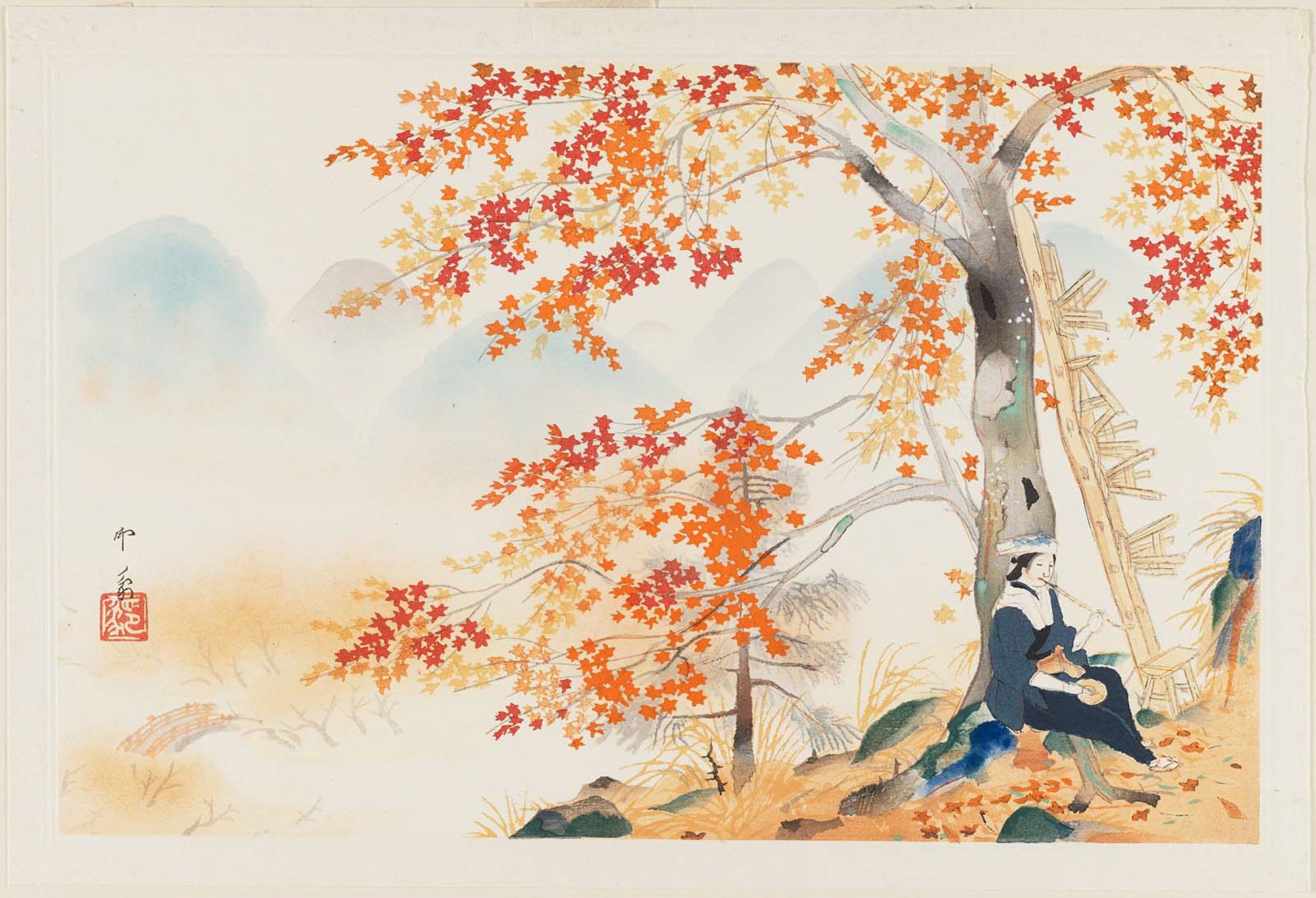
Autumn Maple Leaves at Takao, from the album Eight Views of Kyoto (Kyôto hakkei)
Woodblock print

The Beach at Kaiganji in Sanuki Province (Sanuki Kaiganji no hama), from the series "Collection of Views of Japan II, Kansai Edition (Nihon fukei shu II Kansai hen)"
1934
Color woodblock print; oban

Tea Kettle, section of a sheet from the series "Mirror of Stone Rubbings of Views of the Provinces" (Kohon meihitsu ishizuri kagami)
n.d.
Woodblock print; ishizuri-e, section of harimaze sheet
Featured in Collections
Curated cross-cuts that include this print.
Frequently Asked Questions
The Fuji River was created by Kawase Hasui (川瀬巴水).
The Fuji River depicts landscapes.