
Tsubosaka Temple, Yamato (Yamato Tsubosakadera)
by Kawase Hasui
- Date:
- 1950
- Medium:
- Color woodblock print
- Format:
- Oban
- Publisher:
- Watanabe Shozaburo
- Edition:
- Published by Watanabe Shozaburo
- Source:
- Art Institute of Chicago
Description
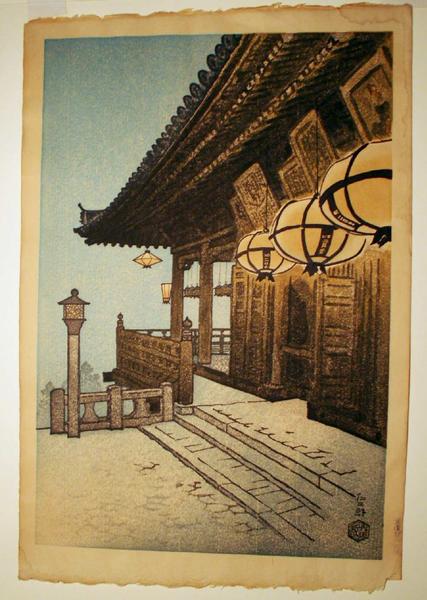
Tsubosaka Temple in Yamato, published in 1950, depicts Tsubosakadera — the Hasedera temple at Tsubosaka in the Yamato Highlands of Nara Prefecture, known for the legend of a blind man's wife who prayed at the temple for her husband's sight to be restored. The temple's hillside setting above the Yamato plain, with its three-story pagoda visible among the trees, offers a quieter alternative to Nara city's crowded monument precincts. Hasui's 1950 composition likely captures the temple's autumn or spring character in the soft Yamato light that gives this sheltered inland region its characteristic atmospheric warmth.
More Prints by Kawase Hasui

More Temples & Shrines Prints
Fushimi Inari Temple
伏見稲荷
Woodblock print

The Compound of the Tenman Shrine at Kameido in the Snow (Kameido Tenmangu keidai no yuki), from the series "Famous Places in the Eastern Capital (Toto meisho)"
c. 1832/38
Color woodblock print; oban
Temple with lanterns
Woodblock print

A Section of the Byodo Temple at Uji (Uji Byodoin no ichibu), from the series "Souvenirs of Travel, Second Series (Tabi miyage dai nishu)"
Uji Byodoin no ichibu
1921
Color woodblock print; oban
Featured in Collections
Curated cross-cuts that include this print.
Frequently Asked Questions
Tsubosaka Temple, Yamato (Yamato Tsubosakadera) was created by Kawase Hasui (川瀬巴水) in 1950.
Tsubosaka Temple, Yamato (Yamato Tsubosakadera) uses Bokashi, on color woodblock print.
Tsubosaka Temple, Yamato (Yamato Tsubosakadera) was published by Watanabe Shozaburo (1950).
Tsubosaka Temple, Yamato (Yamato Tsubosakadera) depicts temples & shrines.