
Falling Star Pine Tree at Zenyôji Temple
- Medium:
- Mokuhanga (Japanese woodblock)
- Image courtesy of
- Saru Gallery
Description
Zenyôji's falling-star pine (ryūsei-no-matsu) is a specimen tree associated with a meteorite legend, and Koizumi treats it as both the compositional anchor and the cultural signifier of the temple precinct. The print likely positions the gnarled pine across the foreground or middle ground, with temple architecture — gate, hall, or stone lantern — receding behind. Carving an aged pine tests a printmaker's keyblock work: the bark's craggy texture and asymmetric needle clusters require fine knife technique against a hardwood block, typically cherry. As a plate from Dai Tokyo Hyakkei (One Hundred Views of Great Tokyo), the work belongs to the meisho-e tradition of famous-place imagery that Koizumi inherited from Hiroshige and adapted to interwar Tokyo. The series, issued between 1928 and 1940, documented landmarks both ancient and modern, and the inclusion of a temple's sacred tree fits its program of cultural inventory across the rebuilt capital.
More Prints by Kishio Koizumi
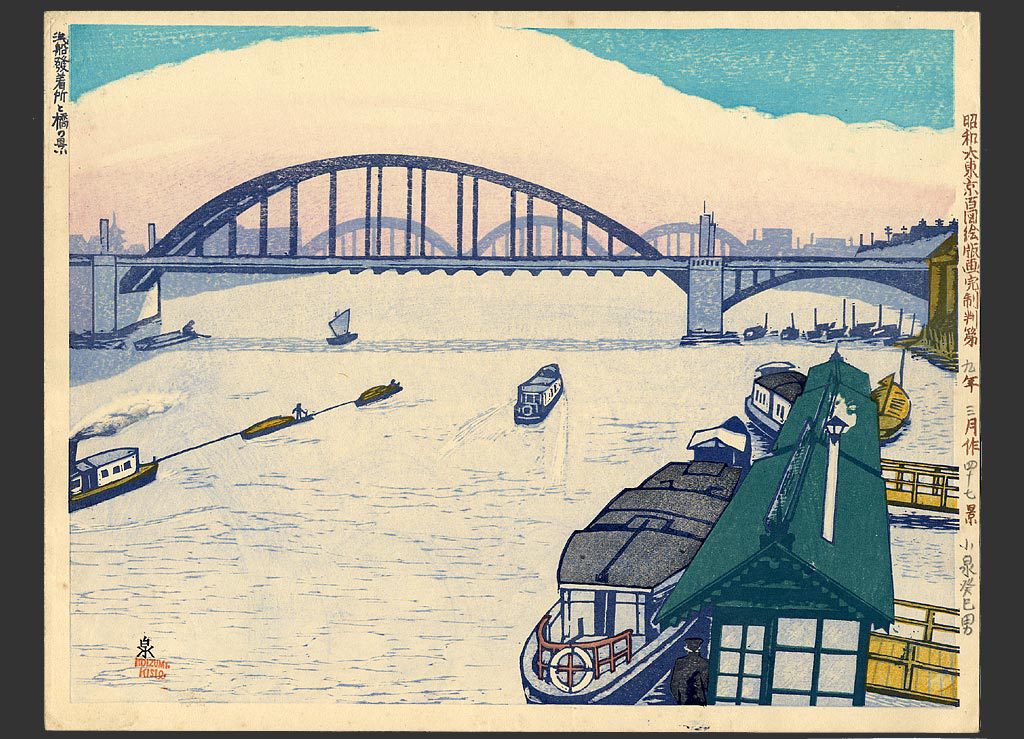
Untitled (kishio-koizumi)
Woodblock print
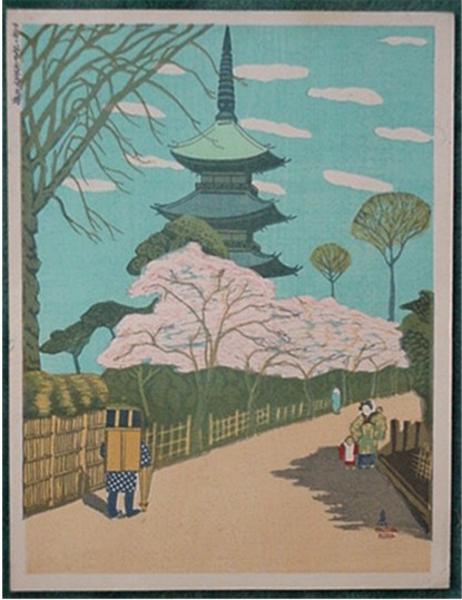
Unknown, spring scene
Woodblock print

Raft In Yoryoko River
Mokuhanga (Japanese woodblock)

Autumn Color along the Moat at Hanzo Gate (Hanzomon go-horihata no aki iro), from the series "One Hundred Views of Great Tokyo in the Showa Era (Showa dai Tokyo fukei hyaku zue hanga)"
1934
Color woodblock print; oban
More Temples & Shrines Prints

Fushimi Inari Temple
伏見稲荷
Woodblock print

The Compound of the Tenman Shrine at Kameido in the Snow (Kameido Tenmangu keidai no yuki), from the series "Famous Places in the Eastern Capital (Toto meisho)"
c. 1832/38
Color woodblock print; oban
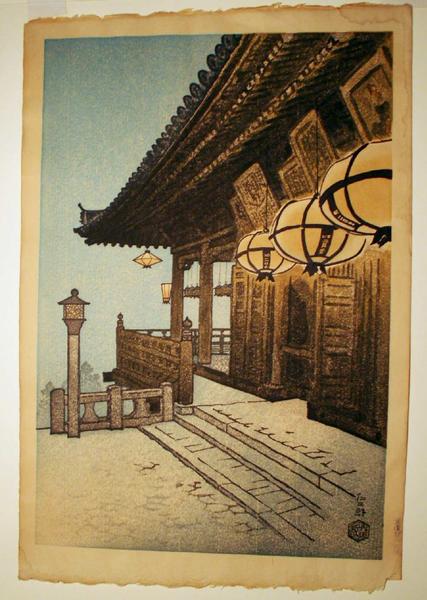
Temple with lanterns
Woodblock print

A Section of the Byodo Temple at Uji (Uji Byodoin no ichibu), from the series "Souvenirs of Travel, Second Series (Tabi miyage dai nishu)"
Uji Byodoin no ichibu
1921
Color woodblock print; oban
Featured in Collections
Curated cross-cuts that include this print.
Frequently Asked Questions
Falling Star Pine Tree at Zenyôji Temple was created by Kishio Koizumi (小泉癸巳男).
Falling Star Pine Tree at Zenyôji Temple depicts temples & shrines and trees.