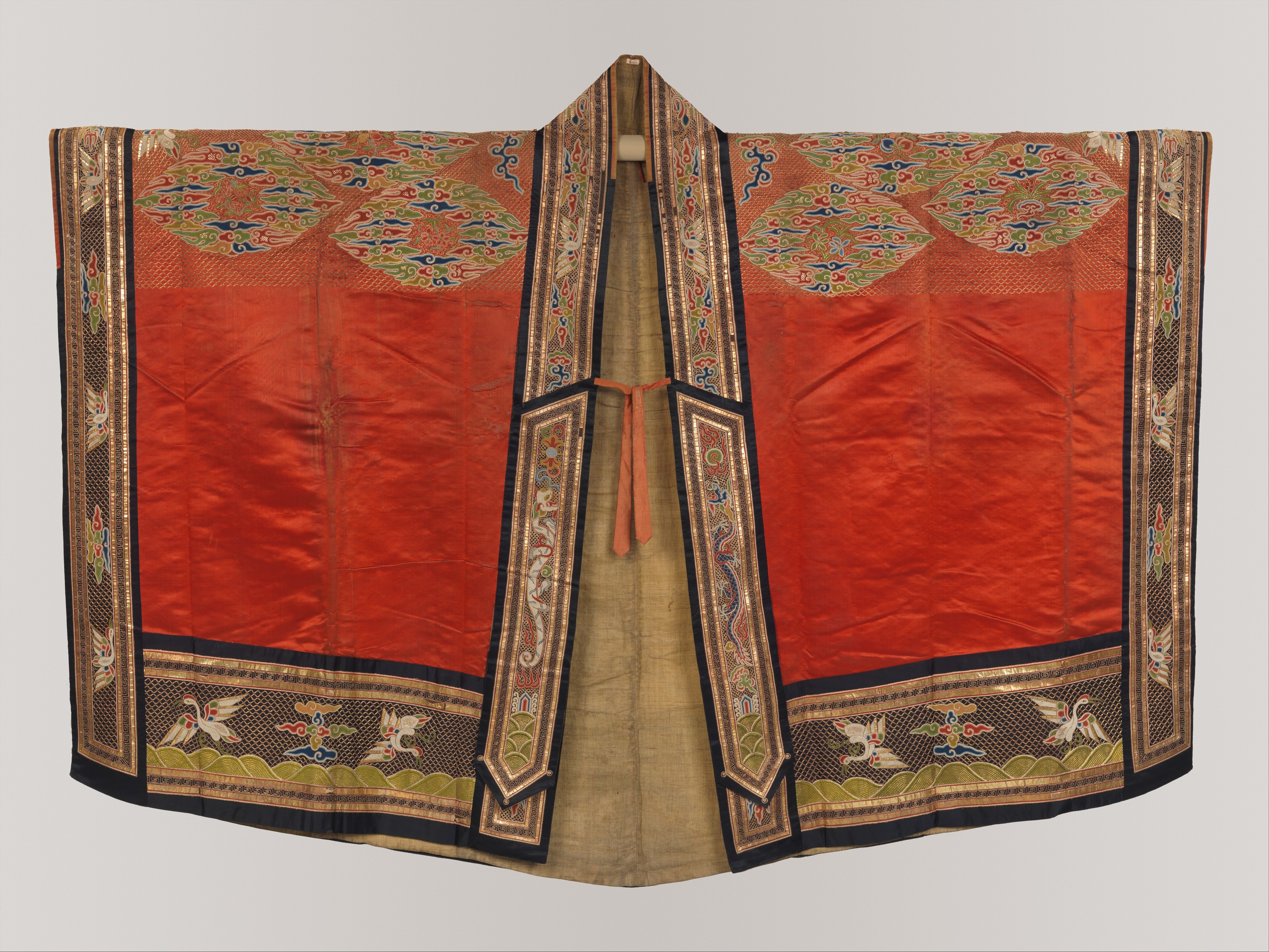
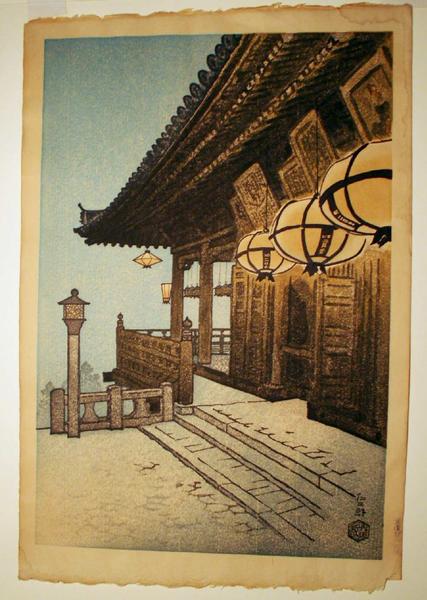
Shiba Zojoji Temple
芝増上寺
- Date:
- 1934
- Medium:
- Woodblock print
- Format:
- Oban
- Dimensions:
- 24 × 36 cm
- Publisher:
- Watanabe Shozaburo
- Edition:
- Published by Watanabe Shozaburo
- Source:
- The Metropolitan Museum of Art
Description
The image at that path does not match the given facts — it shows a textile, not a woodblock print: a red silk garment (robe/vestment) laid flat, with elaborate gold-metallic brocade borders featuring cranes in flight, stylized wave patterns, and cloud-and-scroll medallions in blue, green, red, and cream. There's a plain tan/khaki lining visible down the center opening, with an orange tie fastener and a fabric loop at the neck for hanging.
This is clearly not "Shiba Zojoji Temple" by Shiro Kasamatsu (which would be a 1934 shin-hanga landscape print of a temple gate) — it's a photograph of an embroidered/brocade robe. I'd flag this as an image/metadata mismatch rather than write a description pretending otherwise. Do you want me to check whether the wrong file landed at that path, or is this intentionally a test of the mismatch-detection flow?
More Prints by Shiro Kasamatsu

More Temples & Shrines Prints

Fushimi Inari Temple
伏見稲荷
Woodblock print

The Compound of the Tenman Shrine at Kameido in the Snow (Kameido Tenmangu keidai no yuki), from the series "Famous Places in the Eastern Capital (Toto meisho)"
c. 1832/38
Color woodblock print; oban
Temple with lanterns
Woodblock print

A Section of the Byodo Temple at Uji (Uji Byodoin no ichibu), from the series "Souvenirs of Travel, Second Series (Tabi miyage dai nishu)"
Uji Byodoin no ichibu
1921
Color woodblock print; oban
Featured in Collections
Curated cross-cuts that include this print.
Frequently Asked Questions
Shiba Zojoji Temple (芝増上寺) was created by Shiro Kasamatsu (笠松紫浪) in 1934.
Shiba Zojoji Temple uses Bokashi, Nishiki-e, and Moku-hanga, on woodblock print.
Shiba Zojoji Temple was published by Watanabe Shozaburo (1934).
Shiba Zojoji Temple depicts temples & shrines, set at Tokyo, Zojoji Temple, Shiba.
Shiba Zojoji Temple measures 24 × 36 cm (Oban format).