
Asama Shrine (Mt.Fuji)
- Medium:
- Mokuhanga (Japanese woodblock)
- Image courtesy of
- Saru Gallery
Description
A weathered stone shrine compound sits atop a barren, rocky summit, framed by a dark wooden roof beam at left and a white torii gate leading to inscribed stone stelae and a small offering hall hung with a shimenawa rope and folded paper streamers. In the muted grey and beige palette, two travelers in blue robes, yellow capes, and wide straw hats walk along the stony path on the right, dwarfed by piles of rubble-like volcanic rock; a bare wooden bench and low stool stand empty in the foreground. Vertical text along the right margin gives the title and artist signature, consistent with the identified work "Asama Shrine (Mt. Fuji)" by Tomikichiro Tokuriki, mokuhanga.
More Prints by Tomikichiro Tokuriki
Heian Shrine in the Spring
Woodblock print
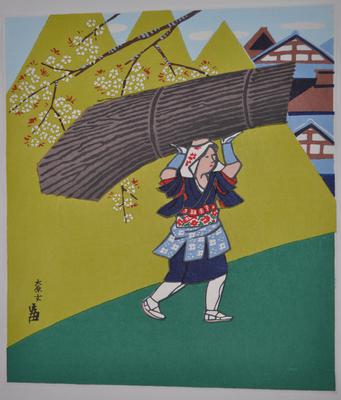
An Oharame Girl Carrying Firewood on Her Head
20th century
Woodblock print, ink and color on paper

April (Arashiyama Park, a Famous Scenic Resort)
四月 (嵐山)
second half 20th century
Woodblock print, ink and color on paper

June (Rainy Scene of the Sen-ke, Japanese Tea Ceremony Founder's House)
六月 (千家雨景)
second half 20th century
Woodblock print, ink and color on paper
More Temples & Shrines Prints
Fushimi Inari Temple
伏見稲荷
Woodblock print

The Compound of the Tenman Shrine at Kameido in the Snow (Kameido Tenmangu keidai no yuki), from the series "Famous Places in the Eastern Capital (Toto meisho)"
c. 1832/38
Color woodblock print; oban
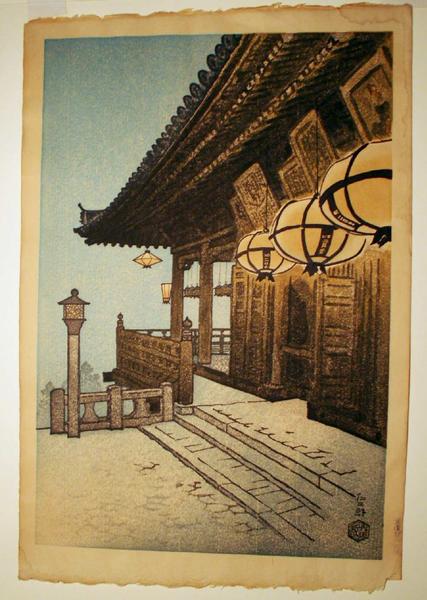
Temple with lanterns
Woodblock print

A Section of the Byodo Temple at Uji (Uji Byodoin no ichibu), from the series "Souvenirs of Travel, Second Series (Tabi miyage dai nishu)"
Uji Byodoin no ichibu
1921
Color woodblock print; oban
Featured in Collections
Curated cross-cuts that include this print.
Frequently Asked Questions
Asama Shrine (Mt.Fuji) was created by Tomikichiro Tokuriki (徳力富吉郎).
Asama Shrine (Mt.Fuji) depicts temples & shrines, mount fuji, and mountains.