
Asama Shrine (Mt.Fuji)
- Medium:
- Mokuhanga (Japanese woodblock)
- Image courtesy of
- Saru Gallery
Description
The image depicts an Asama shrine—a Shinto institution dedicated to Konohanasakuya-hime, the deity of Mount Fuji—framing the mountain through or alongside shrine architecture. Vermilion torii or shaden roofs typically anchor the foreground while Fuji's cone rises behind, rendered through bokashi gradation that runs from deep indigo at the base to the unprinted white of the washi for the snow cap. Tokuriki's Fuji subjects draw on the meisho-e (famous views) tradition that Hokusai and Hiroshige established, but his palette is distinctly twentieth-century: saturated and mineral-hued. As the twelfth-generation head of a Kyoto family that had supplied prints to Honganji Temple since the Keicho era, he brought a fluency with religious architecture into his landscape practice. This print belongs to the broad current of Mount Fuji subjects he produced from the 1930s through the postwar decades, issued through Uchida and other Kyoto publishers.
More Prints by Tomikichiro Tokuriki
Heian Shrine in the Spring
Woodblock print
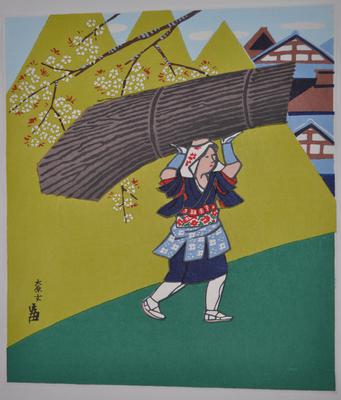
An Oharame Girl Carrying Firewood on Her Head
20th century
Woodblock print, ink and color on paper

April (Arashiyama Park, a Famous Scenic Resort)
四月 (嵐山)
second half 20th century
Woodblock print, ink and color on paper

June (Rainy Scene of the Sen-ke, Japanese Tea Ceremony Founder's House)
六月 (千家雨景)
second half 20th century
Woodblock print, ink and color on paper
More Temples & Shrines Prints
Fushimi Inari Temple
伏見稲荷
Woodblock print

The Compound of the Tenman Shrine at Kameido in the Snow (Kameido Tenmangu keidai no yuki), from the series "Famous Places in the Eastern Capital (Toto meisho)"
c. 1832/38
Color woodblock print; oban
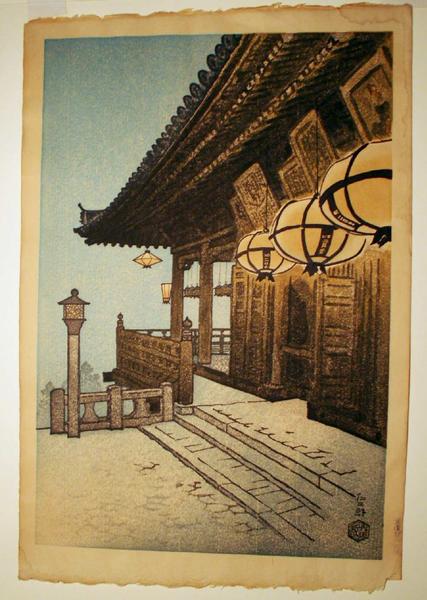
Temple with lanterns
Woodblock print

A Section of the Byodo Temple at Uji (Uji Byodoin no ichibu), from the series "Souvenirs of Travel, Second Series (Tabi miyage dai nishu)"
Uji Byodoin no ichibu
1921
Color woodblock print; oban
Featured in Collections
Curated cross-cuts that include this print.
Frequently Asked Questions
Asama Shrine (Mt.Fuji) was created by Tomikichiro Tokuriki (徳力富吉郎).
Asama Shrine (Mt.Fuji) depicts temples & shrines, mount fuji, and mountains.