
Garden Of Heain Jingu Shrine
- Medium:
- Mokuhanga (Japanese woodblock)
- Image courtesy of
- Saru Gallery
Description
Heian Jingu, built in 1895 to commemorate the 1,100th anniversary of the founding of Heian-kyo, is set within the Shin'en garden designed by Ogawa Jihei VII. Tokuriki, working in Kyoto throughout his career, returned to this site repeatedly. This first variation likely depicts the southern garden in spring, with the weeping cherries (shidare-zakura) that drape over the pond and stone paths. The composition would rely on a high horizon and a foreground of cherry blossom rendered through carefully cut color blocks, with bokashi gradation suggesting depth in the water. The saturated palette and crisp register characteristic of nishiki-e printing suit the pinks of the cherries against the deep green of the garden's pines. Garden views of Heian Jingu form a recurring motif within Tokuriki's meisho-e output, where Kyoto's seasonal landmarks anchor a body of work that drew on shin-hanga conventions to document the city's twentieth-century appearance.
More Prints by Tomikichiro Tokuriki
Heian Shrine in the Spring
Woodblock print
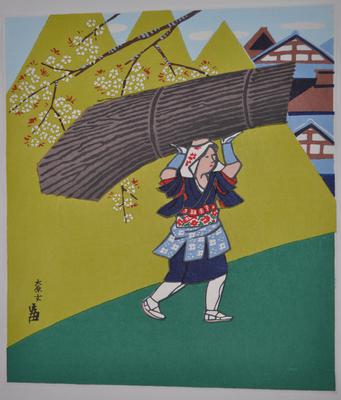
An Oharame Girl Carrying Firewood on Her Head
20th century
Woodblock print, ink and color on paper

April (Arashiyama Park, a Famous Scenic Resort)
四月 (嵐山)
second half 20th century
Woodblock print, ink and color on paper

June (Rainy Scene of the Sen-ke, Japanese Tea Ceremony Founder's House)
六月 (千家雨景)
second half 20th century
Woodblock print, ink and color on paper
More Temples & Shrines Prints
Fushimi Inari Temple
伏見稲荷
Woodblock print

The Compound of the Tenman Shrine at Kameido in the Snow (Kameido Tenmangu keidai no yuki), from the series "Famous Places in the Eastern Capital (Toto meisho)"
c. 1832/38
Color woodblock print; oban
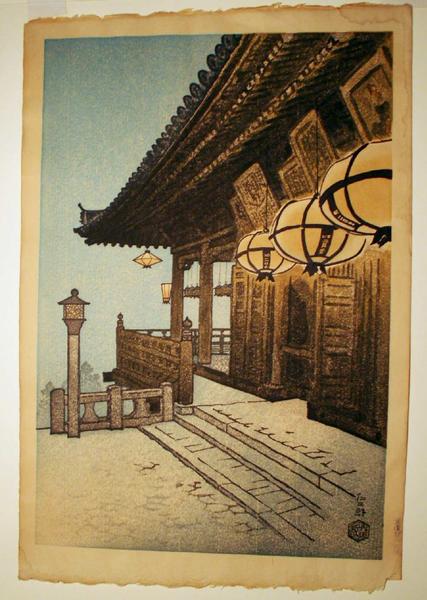
Temple with lanterns
Woodblock print

A Section of the Byodo Temple at Uji (Uji Byodoin no ichibu), from the series "Souvenirs of Travel, Second Series (Tabi miyage dai nishu)"
Uji Byodoin no ichibu
1921
Color woodblock print; oban
Featured in Collections
Curated cross-cuts that include this print.
Frequently Asked Questions
Garden Of Heain Jingu Shrine was created by Tomikichiro Tokuriki (徳力富吉郎).
Garden Of Heain Jingu Shrine depicts temples & shrines and gardens.